
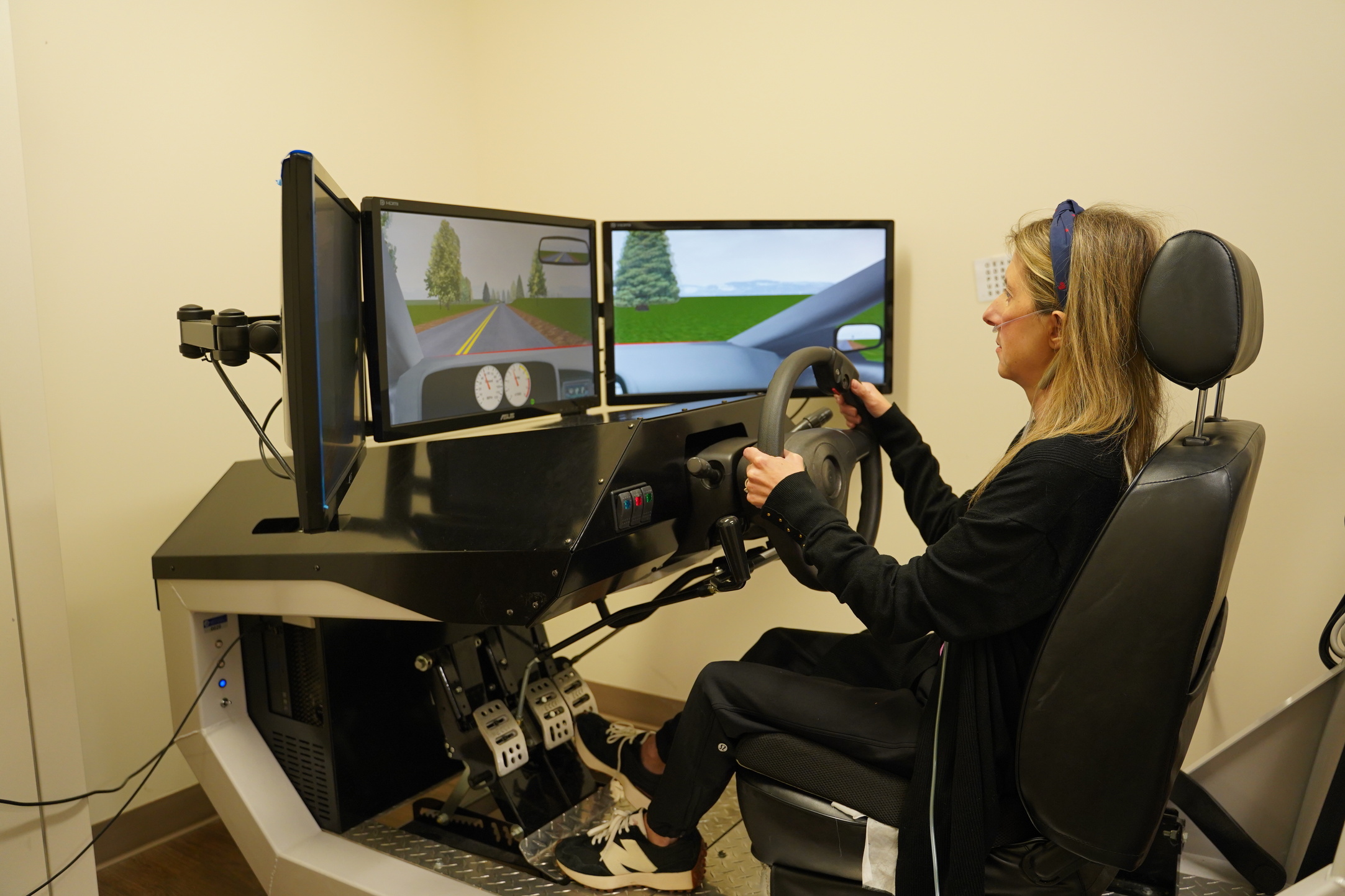
At Madonna Rehabilitation Hospitals, our interdisciplinary teams care for some of the most complex medical rehabilitation patients in the nation. When Annie Sova arrived at Madonna’s Specialty Hospital after eight weeks at Methodist Health System, she was critically ill, deconditioned and in need of extensive medical support.
“In the Specialty Hospital, these are patients who could easily still be in an acute care setting,” said Dr. Susan Ohnoutka, MD, medical director of Madonna’s Specialty Hospital. “Annie was on a ventilator. She was awake and alert, but very sick.”
A Life-Threatening Diagnosis
Annie’s medical journey began on Father’s Day in June 2025. After lunch with her family, she developed severe stomach pain. Initial lab work was normal, but a CT scan revealed the cause.
“That’s when I feel like I had everyone in the hospital come into my room,” Annie said.
Doctors diagnosed Annie with a volvulus, twisting of the large intestine, that required emergency surgery.
“I was told if they didn’t do surgery that day, I would pass away,” Annie said. “But even with surgery, there was a big chance I might not make it.”
Annie survived the operation, but complications led to multi-organ system failure. She required ventilator support and dialysis, giving her heart, lungs, kidneys and gastrointestinal system time to heal.
Specialty Hospital Lays the Groundwork
After transferring to Madonna’s Specialty Hospital, Dr. Ohnoutka evaluated Annie daily to ensure medical stability while ramping up the intensity of therapy.
“When patients come from acute care this sick, they often haven’t been out of bed for a long time, especially if they’ve been on a ventilator,” Ohnoutka said. “Right away, we’re getting them up in a chair and working with therapy to strengthen respiratory and core muscles.”
With support from an interdisciplinary team that included physicians, nurses and respiratory therapists, Annie gradually weaned from the ventilator. Her kidney function improved and she no longer needed dialysis.
Throughout her recovery, Annie felt supported not only physically, but emotionally and spiritually.
“They took the time to answer questions, and Dr. Goodwin actually prayed with me and my husband,” Annie said. “That was incredibly powerful. I knew I had a long road ahead, but I trusted God and my care team.”
Moving Through the Continuum of Care
As Annie’s strength returned, she transitioned to Madonna Rehabilitation Hospital for more intensive therapies.
“Annie is a great example of the Madonna continuum of care,” Carly Poldberg, M.A. CCC-SLP, Annie’s speech-language pathologist, said. “When she came to the rehabilitation hospital with me, we were tying a nice little bow on everything and improving her respiratory strength, her endurance, and working on some cognitive skills to take care of her children, as a mom of two twin boys.”
Because Annie had built a strong foundation in the Specialty Hospital, therapy in rehabilitation focused on confidence and independence.
“After a long medical stay, it can be nerve-wracking and scary to go back home and I feel like we highlighted to her that she can do this,” Poldberg said. “She came in and worked hard every day, and when she realized she was capable, she was unstoppable.”
Annie progressed quickly. Supported by her husband, Joe, and her sons, she went from taking just a few steps to walking the full length of Madonna’s main hallway. Her oxygen needs decreased, and her stamina steadily improved.
Rehabilitation Day Program Centers on Return to Community
Annie returned home Sept. 24, but her recovery continued through Madonna’s Rehabilitation Day Program. There, therapy became increasingly focused on real-life goals and daily routines.
“We wanted to get her back to being a mom—playing with her kids and taking them where they need to go,” said Tina Meier, PT, DPT, Annie’s physical therapist. “She also volunteers, so that was important to her. We worked on walking, stairs and endurance to support those roles.”
Technology like Madonna’s driving simulator allowed Annie to safely practice returning to the road. The simulator challenged her reaction time, dual-tasking skills and overall driving safety before she drove independently.
Community outings, including trips to the grocery store, helped Annie navigate real-world environments while still being supported by her therapy team.
“The trip to Walmart was an ‘aha’ moment for me,” Annie said. “I tried to keep up with everyone, and by the time we got back to make the food we bought, I was exhausted. I learned I needed to go at my own pace, take breaks and plan ahead.”
Helping Annie listen to her body became an important part of therapy.
“We had to tell her to pump the brakes,” Meier said. “She wanted to do everything at once. Recovery takes time, and it may not look like it did before, but she’ll get there.”
Even on days when Annie was exhausted, her care team noticed her determination.
“She has a persevering personality,” Meier said. “No matter what life throws at her, she’s going to find a way through it.”
Annie credits her resilience to her faith, her family and her care team.
“I knew it was the only way I was going to be able to get back to my life, so I trusted the process,” Annie said.
From Ventilator Support to Volunteering at Madonna
Today, Annie has returned to full-time motherhood and continues volunteering in the community. She enjoys working with both the Ronald McDonald House and Madonna’s Foundation. In the future, Annie says she’d like to spread awareness and serve others who have experienced medical complications and multi-organ failure. She encourages others facing complex medical journeys to celebrate small victories.
“I’ve gone from being on a ventilator with a trach and dialysis to going to a Creighton game and attending church with my family,” Annie said. “I never imagined that would be possible when I first got home. I feel stronger and more confident.”
As she reflects on her recovery, Annie says gratitude alone does not fully capture her experience.
“They trusted me, and I trusted them,” she said about her care team. “Madonna didn’t just give me therapy. They gave me hope. When expert care meets compassion, incredible things can happen.”