
For Phil Zeutenhorst, a first responder from Hospers, Iowa, the call to help others had defined his life for years.
“I was a volunteer firefighter,” Phil said. “You get to help people out when they’re having the worst day of their lives.”
But during a routine simulation, that role suddenly reversed.
“We were doing a training exercise,” Phil said. “We do live fires and it flashed over on me.”
The injury was severe, resulting in extensive burns and a long, complex medical recovery that began in a critical care setting.
“Phil had 25 to 27% burned on his body,” Helen Zeutenhorst, Phil’s wife, said. “It was his back, most of his arms, his hands, some on his shoulders, his thigh, both calves…and mainly third degree.”
“He ended up having 16 surgeries.”
From the earliest days of recovery, his care would move through multiple levels of specialized treatment — spending more than 100 days at CHI Health St. Elizabeth’s burn unit and continuing into Madonna Rehabilitation Hospitals for intensive rehabilitation.
“We come from a small town and in a small rural area, and there’s just not a lot of burn knowledge close to us,” Helen said. “The night that Phil got burned, the doctor in the emergency room was confident in Lincoln’s ability to help. We trusted him and I’m so glad we trusted him.”
Even as treatment stabilized his condition, the severity of his injuries, — particularly to his hands — raised difficult questions about long-term function.
“Originally, they had talked about amputating the tips of all the fingers on his right hand,” Helen said. “And everything but his thumb came back.”
Transition into Rehabilitation
Phil’s transfer to Madonna’s Specialty Hospital marked a shift into a highly specialized phase of recovery — designed to support both ongoing medical needs and the introduction of rehabilitation after severe injury.
“We had heard amazing things,” Helen said. “This was our best chance for Phil to gain back as much as he could.”
At this stage, care became coordinated across disciplines, with physicians and wound care nurses supporting healing while therapy focused on restoring movement and function.
“It was a great place for him to start because he kind of left the safety net of the burn ICU,” Jackie Benson, OTR/L, CLT, a Madonna occupational therapist, said. “We’re going to give you a little bit more space, give you a little bit more to do.
His therapists carefully reintroduced mobility, helping his body tolerate movement again.
“A lot of it’s just giving them permission to move and encouraging them to move,” Benson said. “Starting to stretch, manual stretching, long duration stretching…help that skin expand.”
Rebuilding Independence
As Phil transitioned to Madonna’s Rehabilitation Hospital, therapy intensified and focused more on a return to daily life.
A key focus was restoring hand function.
“He had maybe a little bit of digit flexion, hardly any at all,” Emily Adams, OTR/L, CBIS, a Madonna occupational therapist, said. “We put a cast and incrementally increased the stretch on his fingers for a prolonged period of time. He tolerated that really well and with that, we could work on more strengthening, more range of motion.”
Over time, those gains began to translate into greater confidence.
“It helped me feel like I was gaining independence,” Phil said.
Therapy expanded beyond clinical exercises into real-life tasks like dressing, eating, and caring for his children.
“We really worked on some more home management skills,” Adams said. “We were in our grocery store and in our kitchen. Obviously, it still is a journey for a while, but getting dressed, eating, cutting up foods, helping play with his kids, he went home doing pretty much everything that he needed to do.”
Caregiver Support and Family Involvement
Helen became an active participant in Phil’s recovery, learning hands-on care techniques that continue at home.
“There’s just a lot of things that you would never think about with Burn Cares,” Helen said. “They showed me lots of tips and tricks of how to put the compression socks on and put the gloves and the sleeves on when they’re kind of hard to do. And they were just really good about walking me through and making sure I was comfortable doing it.”
That training reflected the broader approach to burn recovery — one that relies on specialized expertise while actively involving families in day-to-day care.
“Having that specialized team to come in and work on burn care, teaching them how to be more independent if they have amputations, learning to navigate that and build up their endurance,” Adams said. “Our ability to complete family training and engage caregivers, like Helen. She helped with showers every day. She would help put on the compression and also having Phil do as much as he could.”
Care teams also focused on preparing the entire family for life after discharge.
“They cared about our family, and they cared about our kids and our friends and life back home and what they could do to help us prepare to go home,” Helen said. “Everyone has gone above and beyond.”
Support even extended into everyday life during a long hospital stay.
“Madonna had lots to offer for our family life, too,” Helen said. “It’s very welcoming. The kids could go play at the park and they could play pool. And our youngest absolutely loved the deer simulator.”
Moments That Mark Progress
Recovery was defined not only by clinical milestones, but by moments that restored identity.
Phil gradually returned to familiar parts of his life.
“He went fishing,” Adams said. “He loves being a dad to his kiddos and that was something that they do all the time, so it was special hearing him tell his kids they can still do all of those things.”
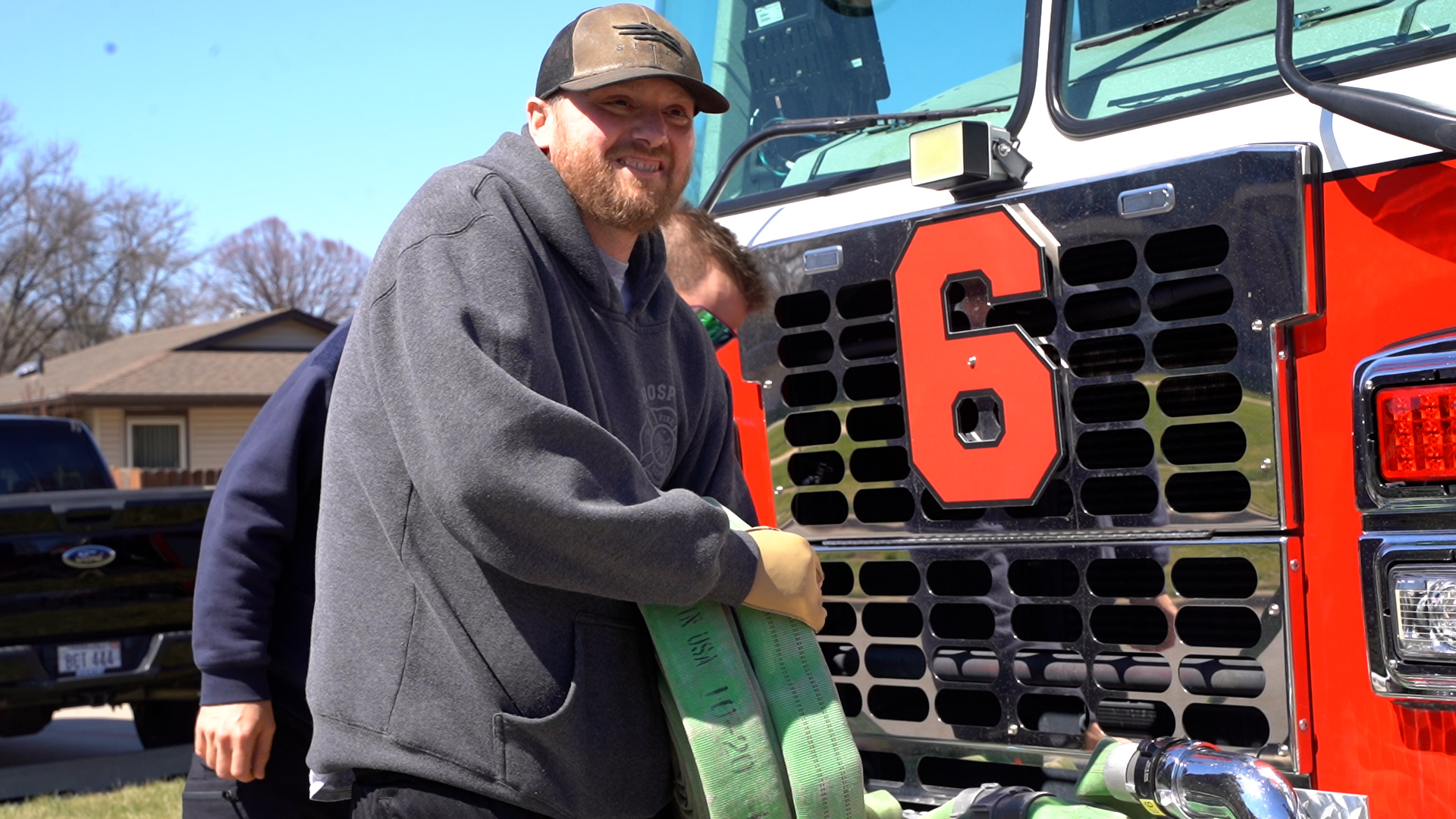
One of the most meaningful milestones came at the fire station.
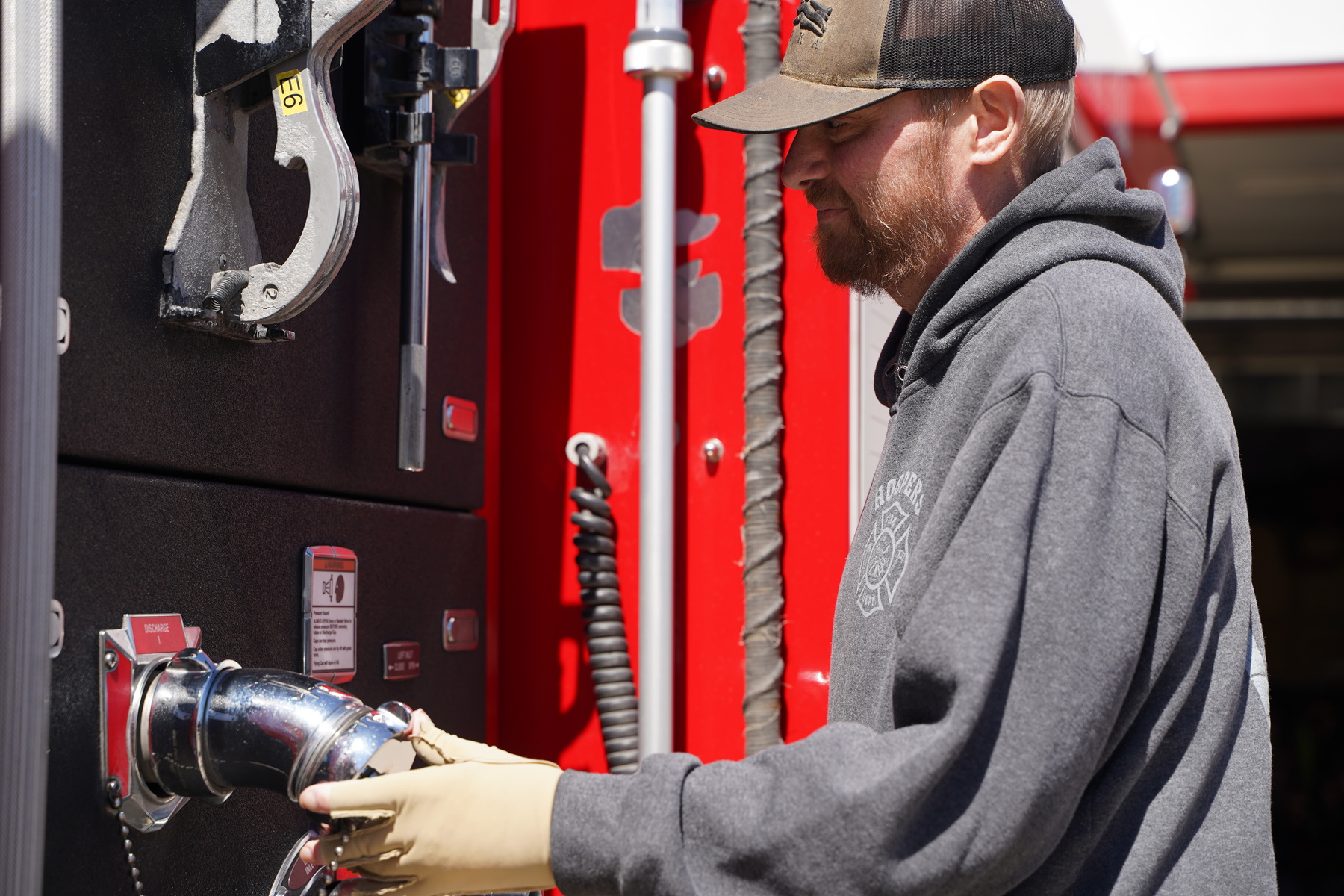
“Going to the fire department was fun,” Phil said. “Dragging the hose out and spraying water.”
That moment carried emotional weight far beyond therapy goals.
“Made me feel like I was getting back into the real world.”
For his therapy team, those experiences reflected something deeper than physical recovery.
“You could see him light up,” Adams said. “For him to realize that he could still hone in on some of those skills… that he could still be a part of that, because that’s extremely important to him being a volunteer firefighter.”
Community Support and What Comes Next
Throughout recovery, Phil was supported by a strong rural community that remained present through every stage.
“Our community has been phenomenal,” Helen said. “They have stepped up and I don’t know how we would have ever done this without our community.”
Even in the hardest moments, his outlook stayed steady.
“He’s been pretty positive,” Helen said. “He went three months, lying in bed, not being able to do anything for himself. That’s a humbling experience, having to rely on other people for absolutely everything and he had such a great attitude throughout all of it.”
As recovery continues with outpatient therapy and future procedures, Phil’s focus is beginning to shift beyond healing alone — and back toward purpose.
“We will start OT and PT in town close to us,” Helen said. “Then we will come back to Lincoln and start laser surgeries to release the scar bands that have formed.”
But one goal has remained consistent throughout his recovery.
“To go back and volunteer again,” Phil said.