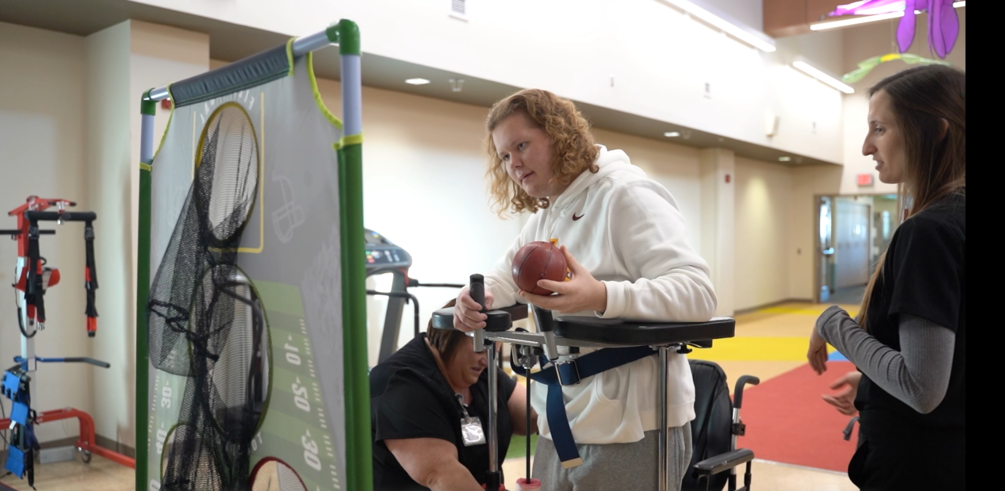
When someone sustains a life-changing traumatic brain injury (TBI), small things that were once taken for granted can suddenly become major hurdles. For 19-year-old Aydan Hofbauer, eating his favorite foods, talking with his family and taking his first steps again became hard-won victories during his recovery. His journey is a powerful example of severe TBI recovery at Madonna.
On Aug. 23, Aydan was involved in a motorcycle accident. He was intubated at the scene and airlifted to a Des Moines hospital, where he spent a month recovering. He remained in a coma for three weeks. When he arrived at Madonna Rehabilitation Hospitals’ specialized disorders of consciousness program, Aydan required a tracheostomy to breathe and could not hold his head upright on his own. His physician-led care team quickly developed a plan to help him emerge into full consciousness so he could begin participating in therapies.
“When someone comes in a minimally conscious state, we initially start completing an assessment called the Coma Recovery Scale,” Megan Jensen, OTR/L, a Madonna occupational therapist, said. “It gives us a number that correlates to their level of consciousness and tracks how they’re emerging. In the beginning, we’re doing anything to overload every system in the body trying to wake it up. I always say we’re being annoying.”
Coma Recovery Scale testing evaluates how patients respond to different stimuli, including temperature, sound and light.
“We’re looking for any kind of response — blinking, a thumbs up, a head nod — anything that shows they’re there and that they understand what we’re asking them to do,” Jensen said.
As Aydan emerged into full consciousness, he began making significant progress in therapy. His mother, Molly Pipal, said she became emotional the first time he responded appropriately to questions, showing he was aware of his surroundings.
“There were times that I was so concerned that he didn’t know who I was or didn’t know who he was,” Molly said. “But the first time they asked him if mom was in the room and he said yes, that was everything.”
Madonna staff used specialized technology to rebuild Aydan’s strength, coordination and breathing — all essential components of severe TBI recovery at Madonna. A functional electrical stimulation (FES) bike activated his arm muscles. The Lokomat robotic gait trainer helped him take his first assisted steps. Speech therapy introduced augmentative and alternative communication (AAC) devices so he could communicate his wants and needs.
“As a speech pathologist, I’m focused on two main things,” said Mary McCallum, CCC-SLP, Aydan’s speech-language pathologist. “How is the patient communicating their wants and needs? And how can we progress their diet so they can safely enjoy the foods they’re craving again?”
After weeks with a breathing tube, Aydan’s neck and throat muscles were weak. He relied on an iPad to type responses as he retrained his voice through speech therapy.
“Aydan’s verbal communication is probably the biggest barrier that he continues to struggle with to this day,” McCallum said. “A lot of technology we used was focused on his breathing patterns and getting his brain to connect to his body, because the basis of speaking is breathing.”
Throughout his recovery, Molly remained at Aydan’s side every day.
“Aydan tends to sit back and let things happen,” Jensen said. “He didn’t always direct his care, so Molly became that voice for him. But not only was she his voice, she was his support. Patients progress quicker when they have that kind of family involvement.”
Molly shared with the care team that Aydan loves to eat at Chipotle. Therapists turned that love into a meaningful therapy goal. Occupational and speech therapy collaborated on a community outing that allowed Aydan to practice real-world skills while celebrating his progress.
For occupational therapy, the outing focused on safely navigating the community in his wheelchair, transferring in and out of a vehicle and problem-solving through new situations. For speech therapy, it meant something equally important: ordering and enjoying his own meal.
“He brought his AAC device and typed out what toppings he wanted,” McCallum said. “It was incredible to see him interact with the world again in such a functional way.”
The first bite of his burrito had the sweet taste of success. The outing also gave Molly a chance to practice the skills she learned through Madonna’s caregiver training program.
“It isn’t easy with the challenges he still has,” she said. “But knowing we could get him in the car, go somewhere and give him a sense of normalcy again was amazing.”
When Aydan first arrived at Madonna, Molly feared he might never speak again. After a month of intensive physical and speech therapy, that fear faded. He went from a small smirk to a full grin, and eventually to laughter.
“He has an audible laugh now, and that was such a gift to hear,” Pipal said. “His voice is still quiet, and he gets fatigued easily, but he’s talking, and he’s working so hard.”
Now back home in Iowa, Aydan and his mom say they are grateful for the care they received and confident they have the tools they need to continue his recovery.