
For 28-year-old Laine Schwehr, racing isn’t just a hobby.
“It’s all I know,” he said.
After eight years of WISSOTA Late Model racing at speeds topping 120 miles per hour, he knew the risks, but the competition and the community made it worthwhile.
But on September 20th, during one of the biggest local races near his hometown of Valley City, North Dakota, Laine was leading his heat when the track conditions got the best of him. The car rolled and the first impact struck the driver’s side window.
“Our race track was really rough and muddy and the car just kind of flipped on it’s own,” Laine said. “When I opened my eyes, I was hanging upside down, my arms were tingling and I couldn’t feel my legs. At some point during the accident, it broke my C5 vertebrae and pushed in four millimeters into my spinal cord.”
He was airlifted to Sanford Medical Center in Fargo, where the extent of his spinal cord injury was confirmed. Laine remembers drawing an imaginary line across his chest to explain the loss of sensation.
“From there down, I had no feeling,” he said. “The doctor told me I would likely never walk again and that I would have limited function.”
Two weeks later, Laine transitioned to Madonna Rehabilitation Hospitals’ specialized spinal cord injury program, where a fresh set of eyes began assessing the full potential of his recovery.
“Laine had central cord syndrome, which means the middle or interior portion of the spinal cord was damaged worse than the outer layer,” Dr. Paul Krabbenhoft, MD, Madonna physiatrist and spinal cord injury medical director, said. “This results in the upper extremities being weaker than his lower extremities.”
From there, Laine’s physician-led care team focused on building a structured and intensive program centered on strength, stability and fine motor control.
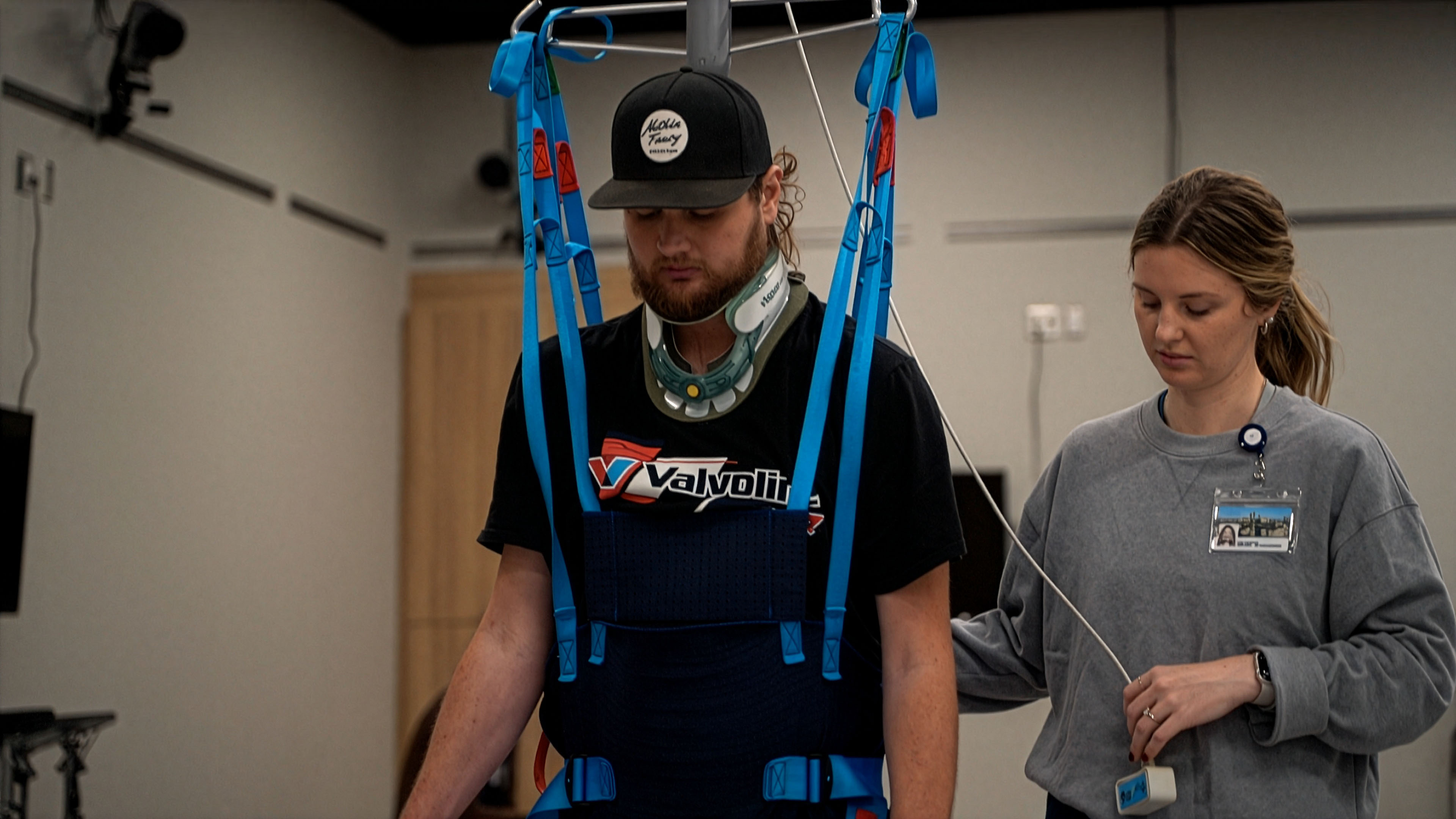
“Standing was very challenging for him,” Laura Selivanoff, PT, DPT, Madonna physical therapist, said. “His ankles almost gave out on his initial evaluation. He was weak and unstable.”
Using specialized bodyweight-supported harness for gait training, Selivanoff tested his coordination and continued to add obstacles to challenge his balance. Within weeks, Laine was walking comfortably with a walker, independently, and was trialing a cane and no assistive device.
His care team also utilized the Proprio 4000 for additional balance training through dynamic range of motion technology.
“Every week we saw improvement,” Selivanoff said.
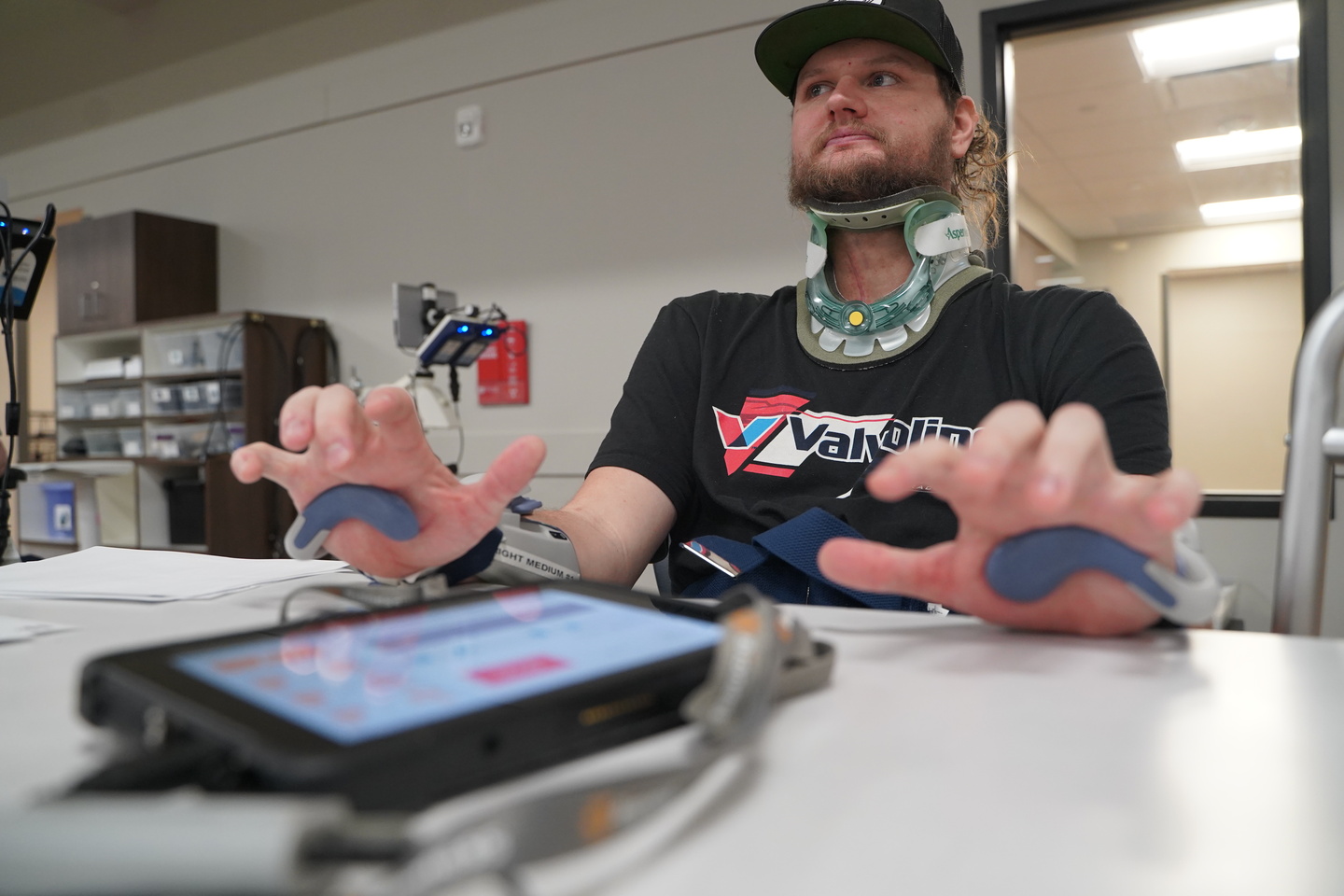
As his legs grew stronger, Laine’s team turned their focus to his hands, struggling with grip and dexterity.
With the help of the Bioness H200, an electrical stimulation device targeting grasp and release, plus hands-on practice in Madonna’s simulated grocery store and fine-motor tasks like building Legos, Laine began retraining the muscles and coordination needed for everyday independence.
As his strength and independence returned, Laine began noticing the changes that once felt impossible.
“I can walk, feed myself, take care of myself,” Laine said. “Everything from when I arrived to now is night and day.”
That momentum fueled his determination to reclaim the parts of life that mattered most to him.
“My big goal was to walk out, get back to life, back to work and back to racing,” Laine said. “Forward progress is good progress, no matter what it is.”
Even when the path forward seemed uncertain, Laine’s positive attitude carried him through.
“He had that ability to keep moving forward and put effort into therapy not knowing what the final outcome would be,” Selivanoff said. “He was saying, ‘whatever I get back is great. I just want to get back doing the things that I love.’”
And once he’s fully cleared to return to the track, there’s no doubt he’ll answer the call and be ready for whatever comes next.
“My story’s not done.”