
Being an elite athlete takes more than talent. It requires grit, determination, perseverance — and the right team. For 16-year-old Sean McMahon, the mindset he developed on the baseball field, combined with Madonna Rehabilitation Hospitals’ expertise and specialized technology, became a powerful formula for recovery after a brain injury.
Sean was working out with friends Feb. 2 when he developed a headache. He initially blamed the intensity of the workout and pushed through until he passed out. He was taken to Children’s Nebraska, where doctors diagnosed an arteriovenous malformation (AVM).
“That means the blood vessels in my head were all tangled and that created a lot of pressure in my head,” Sean said. “They had to take out part of my skull to relieve the pressure.”
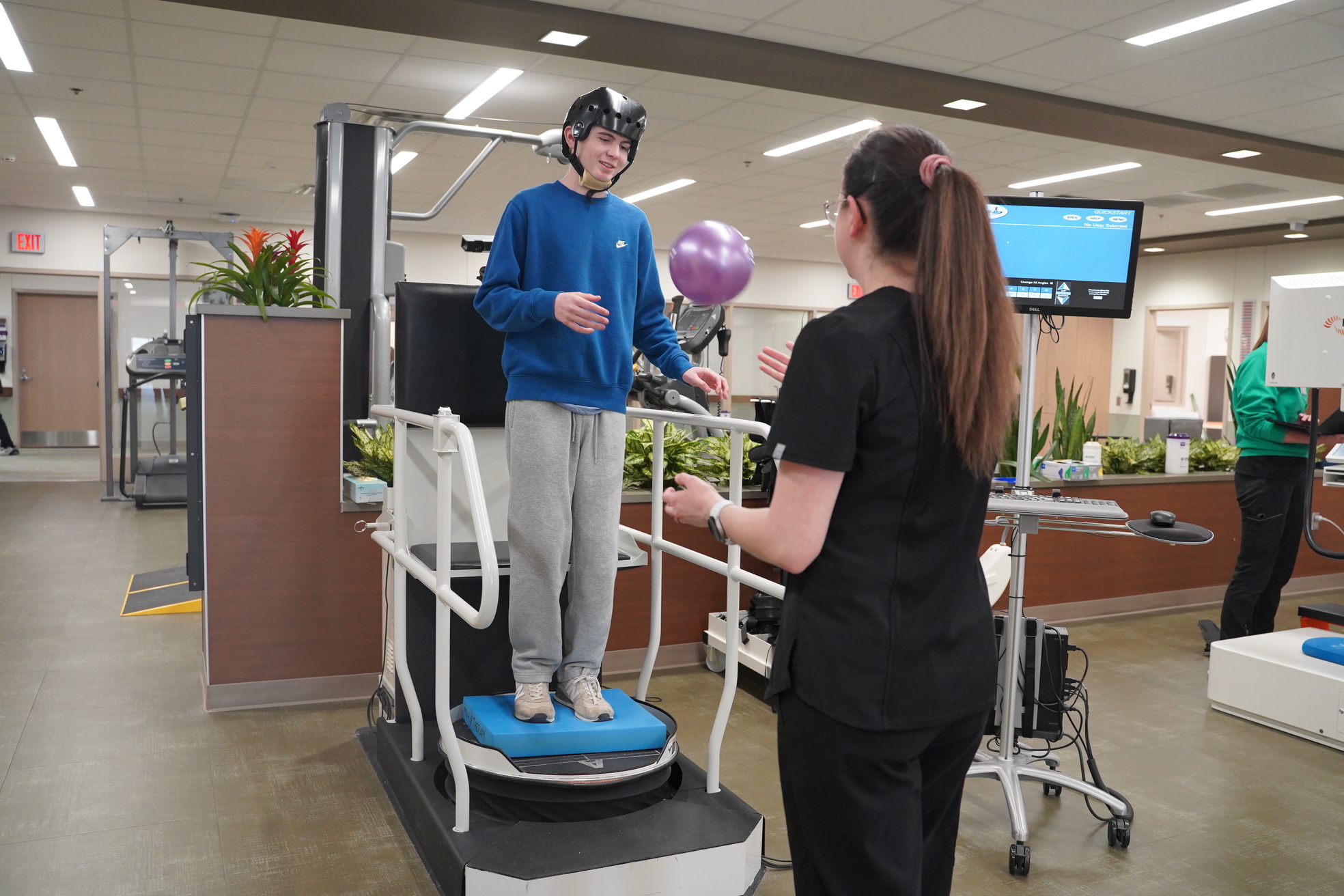
After two weeks at Children’s Nebraska, Sean transferred to Madonna’s specialized pediatric brain injury program, ready to approach recovery like practice. He treated each day like training, focusing on improving balance, coordination and cognitive function through targeted therapy.
“When Sean first got here, he was very impulsive,” Haley Haefner, PTA, Sean’s physical therapy assistant, said. “He would get up without it being in a safe environment. He had very bad left-side inattention, so he did not recognize what was on the left side of his body. He’d run into doorways and people.”
Recovery began with the fundamentals. Madonna’s on-site neuro-optometrist developed a vision therapy plan tailored to Sean’s age, goals and daily life.
“Not just for activities of daily living, but for school, sports and eventually driving,” said Aubrey Janousek, MOT, OTR/L, CBIS, an occupational therapist.
Specialized technology helped gamify therapy, tapping into Sean’s competitive nature. He tracked his progress and pushed himself to improve with each session.
“When you’re working with kids and teenagers, you have to keep it engaging or they won’t buy in,” said Alysa McKenny, OTR/L, CAPS, an occupational therapist. “We incorporated sports he enjoys, photography and even some time on the driving simulator to make therapy more exciting.”
Using familiar sports movements helped retrain Sean’s brain and body. Basketball drills improved speed and endurance. Baseball exercises strengthened hand-eye coordination. Golf, introduced through recreation therapy, helped rebuild balance while standing and walking.
With support from his care team and his own determination, Sean didn’t just return to baseline. He exceeded expectations.
“If you would’ve seen Sean on day one and then a few weeks later, you’d ask, ‘Is that the same kid?’” McKenny said. “He really started to come back to himself.”
Janousek said Sean’s competitive nature played a key role in recovery.
“He was very high achieving before his AVM rupture, and that only helped him and fueled him to get back to that high level,” Janousek said. “He had really big goals for himself and he strived every day to meet them.”
While therapists can guide recovery, they can’t teach resilience. Sean’s perseverance stood out to his care team.
“There wasn’t anything that he didn’t think he could do, so he was always willing to try,” McKenny said. “Even if he failed at first, he wanted to try again. He was willing to ask for help when he needed it and was just really involved in his own recovery process.”
Now back home, Sean is focused on what matters most — school, sports and time with friends. While his path in athletics may look different, he knows he can still do what he loves. Through it all, he’s learned to adapt and trust his work ethic.
“I’m most proud of myself for my consistent work and getting up every day even when it’s hard, and wanting to get better at myself,” Sean said. “I also want to give a big thank you to all my therapists for getting me back to my normal self.”