
Horses have always been a part of Casey Daniel’s life. From early mornings working and training to time spent rodeoing, they shaped both his routine and his career. But after a work-related accident left him with a traumatic brain injury, Casey faced a challenge unlike any he had experienced before: learning how to walk, think and live independently again at Madonna Rehabilitation Hospitals.
“You always put the horse first,” Casey said. “That’s the reason I’m sitting where I’m at now, because that’s my life. I made a living off them and made a life out of it too.”
While pushing cattle at a family feedlot in Red Cloud, Nebraska, that life changed in an instant.
“One decided it wasn’t getting pushed up,” he said. “It turned around and flipped my horse over on top of me. Then the cow came back on top of that, and all of it ended up on top of my head.”
Casey was taken to Good Samaritan Hospital in Kearney before being life-flighted to Bryan Medical Center in Lincoln, where he spent two weeks in the intensive care unit.
“When he woke up, his eyes were open and he was moving, but he could barely hold his head up or walk,” Pam Cooper, Casey’s mom, said. “The outlook was really gloomy, which is why we were coming to Madonna — to try and get him back to as close to 100 percent as possible.”
When Casey arrived at Madonna’s Specialty Hospital, he still had a tracheostomy, a feeding tube and very little memory of the accident.
“My memory wasn’t that good to begin with,” Casey said. “I never got a super good hand to start out with, so I just played the one I got dealt and made the best of what I could.”
A Multidisciplinary Approach to Recovery
“Casey was what we call a Rancho Los Amigos level five, which is alert but confused,” Dr. Matt Driewer, a Madonna internal medicine hospitalist, said. “He was able to learn new information but [was] very impulsive. He could answer simple questions and follow simple one-step commands, but he wasn’t able to follow more complex commands.”
At Madonna’s Specialty Hospital, the team carefully coordinated his care, managing complex medical needs while beginning early rehabilitation.
“We were concentrating on the medical side of things with the pulmonology team and the respiratory therapy team, and physiatrists were focusing on the therapy aspect of things,” Dr. Driewer said. “Ultimately, the goal of the specialty hospital is medical stability, and the rehabilitation hospital is a springboard to get them home and for Casey, home was North Carolina.”
Intensive Therapy Tailored to a Life Around Horses
As Casey improved, he transitioned to Madonna’s Rehabilitation Hospital, where therapy became specialized and more connected to the life he wanted to return to.
“He was fairly high functioning, so we really challenged him with high-intensity gait training,” Nicole Ford, PT, DPT, CBIS, a Madonna physical therapist, said. “We added weights, had him pull our drag bag, just strengthening his core. We took him outside to walk on the uneven ground, longer distances to work on his endurance. He would sometimes fall to the right because that was his weaker side, so we made sure to have dynamic environments to work on that higher-level balance.”
Casey also trained using specialized technology, including the Proprio 4000, a range-of-motion balance platform, to challenge his strength and stability.
“The closest thing I can relate that thing to is when I used to stand on a basketball before I’d ride bulls,” Casey said. “It’s a pretty cool machine.”
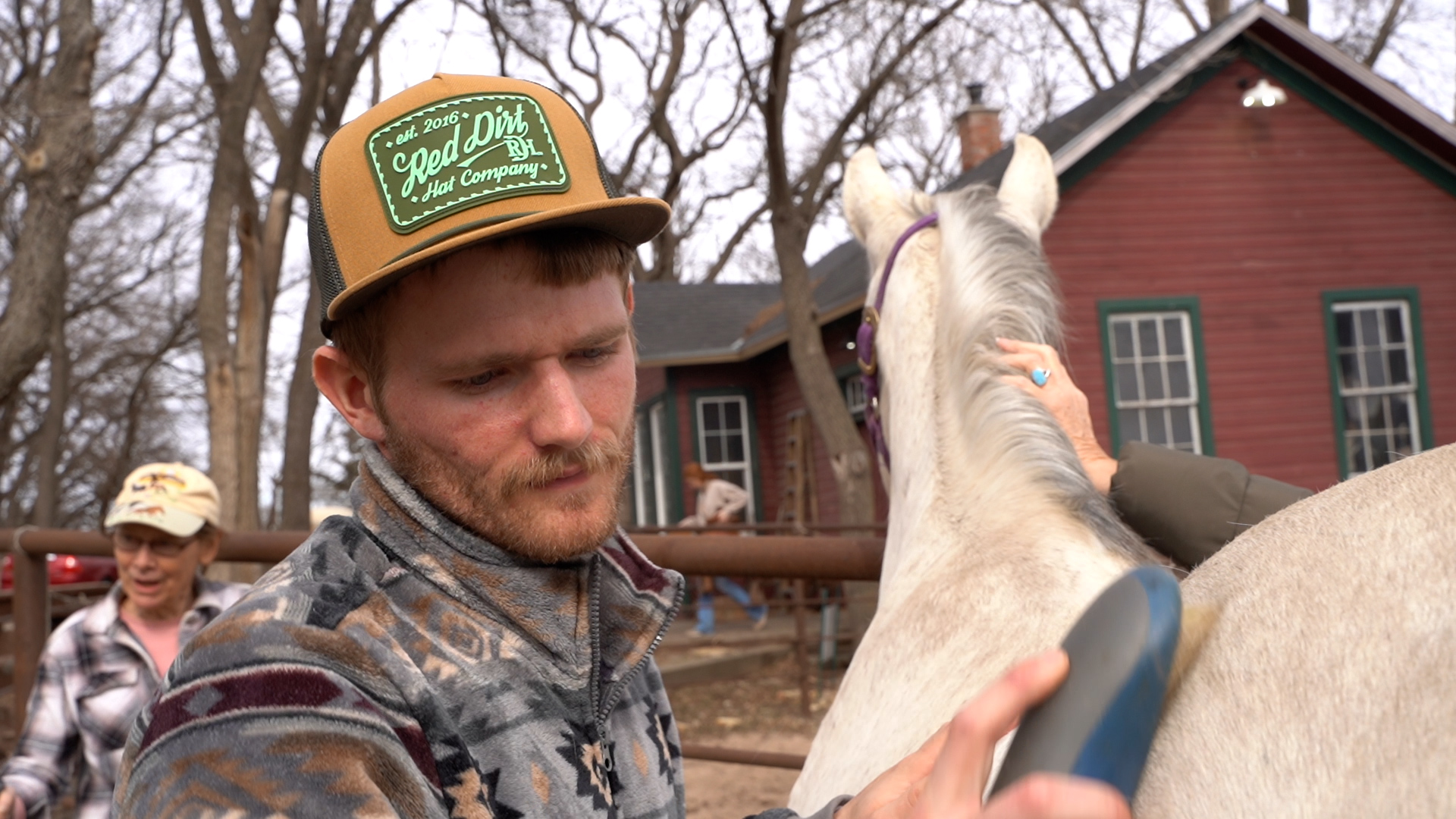
Knowing how important horses were to him, Casey’s physician-led care team incorporated equine therapy into his recovery.
“He got to saddle the horse; he got to brush the horse. He was in his own element,” Ford said. “He did it like it was an old hat. Even interacting with the horse was therapeutic for him.”
Those moments became powerful motivation as he worked toward the life he wanted back.
“(He had) to prove to (himself) that (he) could still do it, that (he) remembered how to do it and (he) had the strength to do it,” Cooper added.
Step by step, Casey began taking the reins again, turning things that once felt impossible into something he could handle.
“Physically, I wasn’t in the best shape to begin with, and the team at Madonna really brought the best out in me and got me back to where I was,” he said. “Probably better than I was, honestly.”
Recovery also meant sacrifice for his family, who traveled from North Carolina to support him through every step of his journey.
“It’s not easy to drive 1,200 miles for your kid or only being home three days in a month’s time,” Casey said. “It’s taken a lot out of a lot of people for me to be here and go through everything I did. I wouldn’t be as far as I am now if it wasn’t for them.”
After leaving Madonna, Casey and his family returned to western Nebraska to collect his horse trailer and dog before heading back home to North Carolina.
Reflecting on the experience, Cooper noted how fortunate they were to have access to such comprehensive care.
“We don’t have anything like this at home in North Carolina,” Cooper said. “All of us have been really blessed that if this had to happen, that it happened here in Nebraska because I don’t think we would be where we are if we hadn’t come to Madonna.”
For Casey, the support and guidance he received made all the difference.
“It pushes you to be better than you were,” Casey said. “If it’s really important to you, this is the place to be, because they want you to succeed just as much as you want to.”