
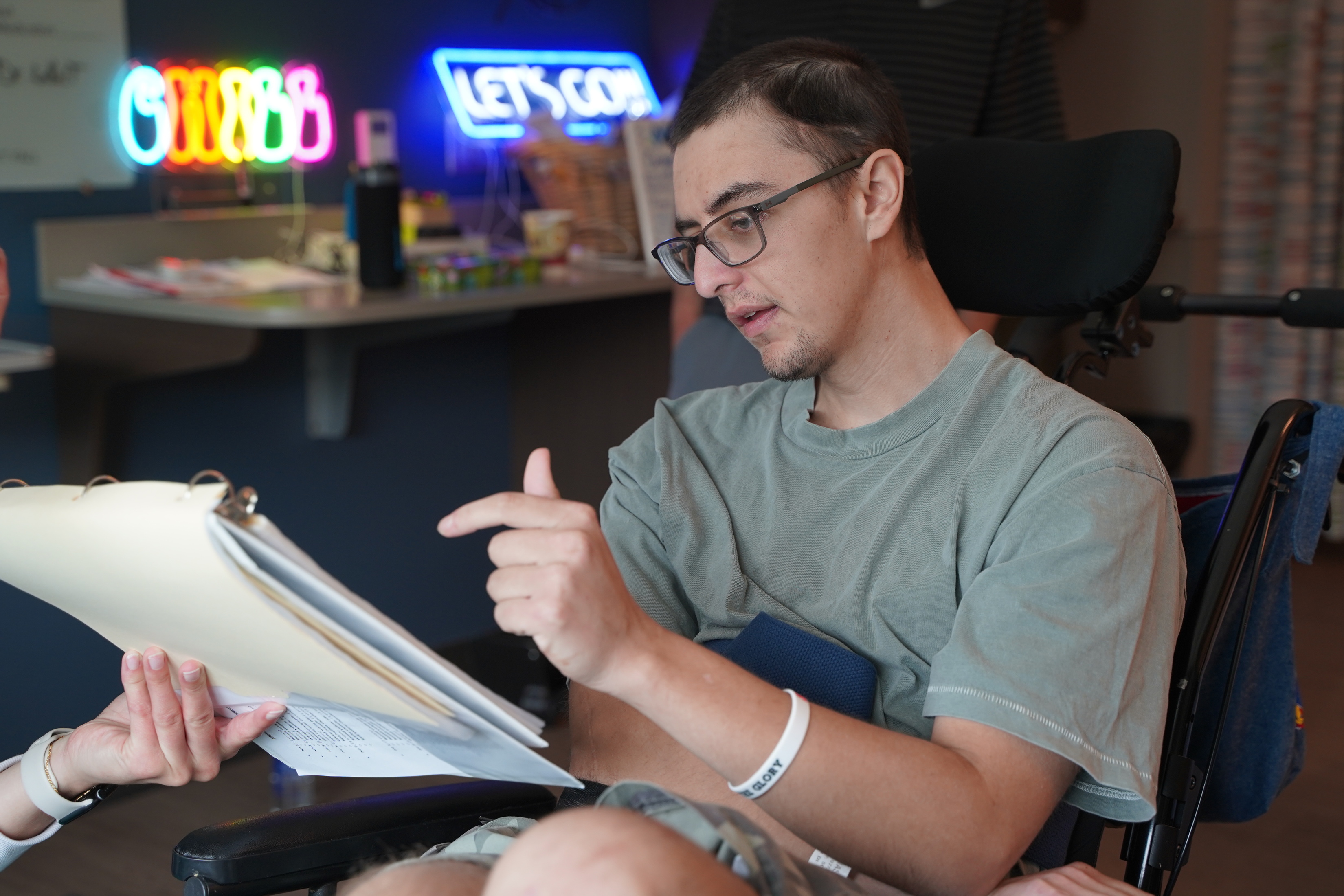
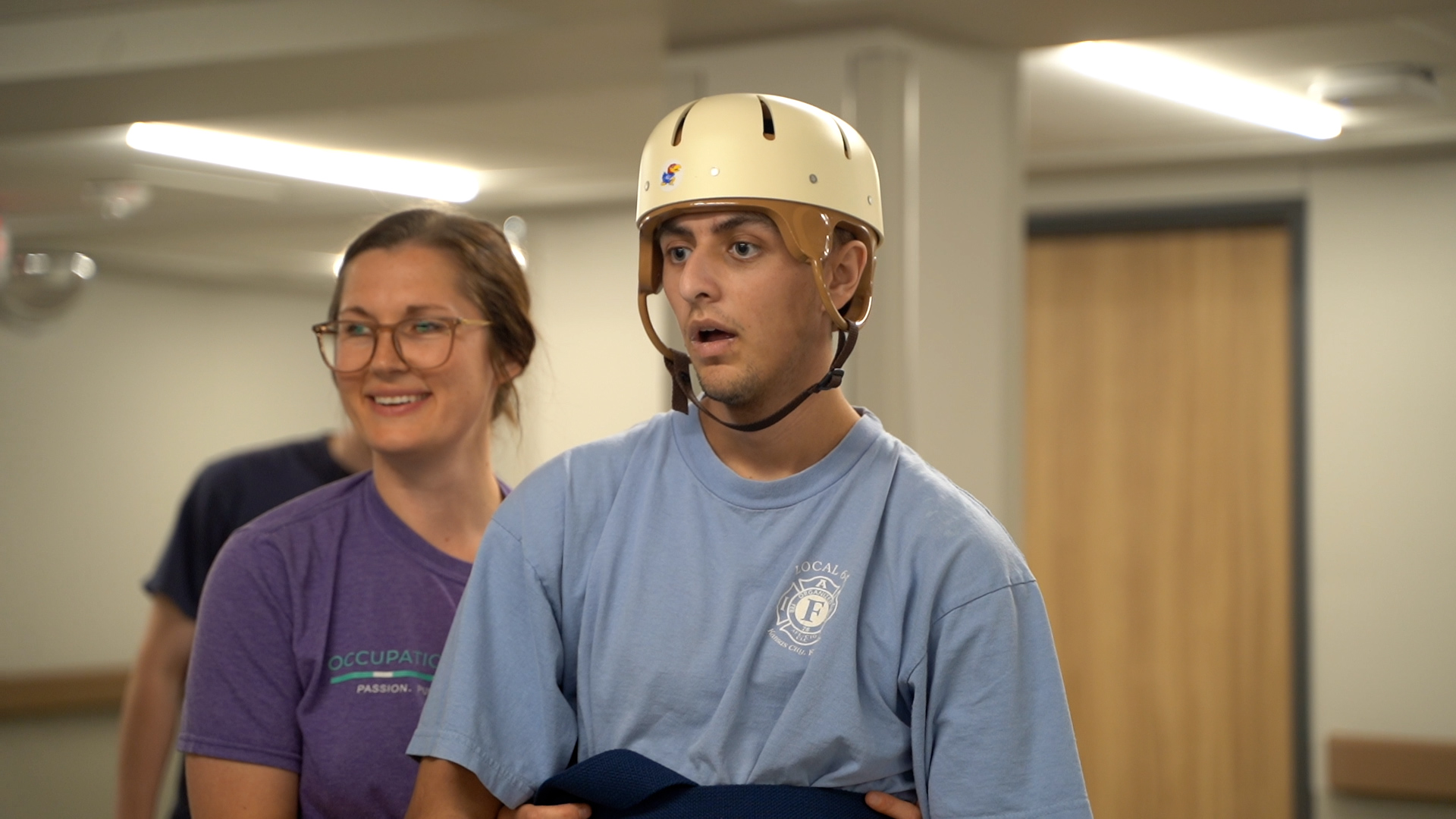
A split second on a Kansas City roadway changed the course of Major Macias’ future.
The 19-year-old sustained life-threatening injuries, including a traumatic brain injury and a severe injury to his left leg that required surgery. After emergency treatment at the University of Kansas Medical Center, where doctors worked to stabilize his injuries, Major transferred to Madonna Rehabilitation Hospitals’ specialized Brain Injury Program to begin the next phase of his recovery.
While Major’s physician-led care team focused on rebuilding his strength and independence, his mom, Amber Macias, hoped for something just as important: seeing her son return to the person she knew and loved.
“I never wanted him to lose who he was or his personality,” Amber said.
Finding His Way Back
Before the crash, Major was known for his big personality. Kind, responsible and always ready with a smile or a story, he was attending HVAC school and working toward a career in the trades.
For his family, the early days after the crash were filled with uncertainty.
“We knew that he had some head trauma, but more critically was saving his left leg and trying to avoid (amputation) because there was a buildup of blood gas in that leg,” Amber said. “It was a double compound fracture that they had to go in and insert a rod.”
When Major arrived at Madonna, his recovery journey included rebuilding strength, mobility, communication and the everyday skills needed to regain independence after a traumatic brain injury.
“You were barely talking. You were not eating. You were very still, very critical,” Amber said. “But you had that fight in your eye and you wanted it.”
That determination was something Major’s care team noticed right away.
“He was so friendly, so appreciative,” Nicole Ford, PT, DPT, CBIS, a Madonna physical therapist, said. “He appreciated everybody all the time. He worked so hard in anything you asked him to do. He would give 100%, and then later in the day would say, ‘Man, that was really hard.’ But he never complained.”
Throughout his recovery, Major’s family remained closely involved, celebrating each milestone while trusting his care team to guide him forward.
“I didn’t really have to advocate for him here because you (Madonna) drove his best, and I was just along for the ride,” Amber said.
Small Steps Lead to Big Progress
Early in his recovery, even the smallest steps required significant effort.
“The first day I got him walking with the very supportive platform walker, he took six steps and then knees buckled,” Nicole said. “Very, very weak. Weak core. His legs were weak. From there, it just went up.”
As Major gained strength, his therapy focused on rebuilding balance, coordination and mobility. His care team challenged him with targeted exercises designed to help him safely return to everyday movement.
“Core strength was a big one,” Ford said. “Getting that trunk control, so, when he did stand upright, he didn’t need so much support. Integrating different dynamic abilities, dual tasking, weighing him down with ankle weights and the drag bag, doing high intensity gait training to get that overall functional strength.”
As Major’s abilities grew, his therapy continued to evolve with him. Specialized technology such as the Proprio 4000 helped safely challenge his balance, while the ICARE by SportsArt elliptical helped build his endurance and the body-weight support treadmill allowed him to practice a more repetitive walking pattern. Together, these provided Major with opportunities to build confidence and independence.
But the tools were only part of Major’s progress. His determination, athletic background and the support of his family and care team helped drive his recovery forward.
“The fact that he was young, fit before, athletic really played a big role in his ability to gain strength back fairly quickly,” Ford said.
Rebuilding Everyday Independence
Recovery after a brain injury is about more than physical strength. It is about rebuilding the skills that allow someone to return to the activities and roles that matter most.
Occupational therapy and speech therapy helped Major regain independence with everyday tasks while giving his family the confidence to step back and allow him to do more for himself.
“That was hard for me as a mom to not do all of those things for him,” Amber said. “I had to really remind myself that you are able to brush your teeth, put your own deodorant on. Emily (Adams, OTD, OTR/L, CBIS) was there to kind of guide you and remind you that you know what to do.”
Getting Major Back
As Major continued to make progress, Amber began seeing the pieces of her son return.
“He’s gotten his spirit back,” she said. “And that was the whole goal.”
The personality that had always made Major stand out was shining through again.
“I can walk,” Major said. “I love that I am capable of doing that. Talking, I love talking.”
For Amber, watching Major’s recovery has been a reminder of his determination and the support surrounding him throughout his journey.
“He was ready,” Amber said. “Even if he couldn’t say it, it was no, I can. You just really brighten up the room.”