
Long before he arrived at Madonna Rehabilitation Hospitals, Cooper Seier knew the value of hard work. Growing up on his family’s farm in Petersburg, Nebraska, the 9-year-old spent his days helping with chores, competing in rodeo and playing sports. Whether he was on the field or around the farm, Cooper was known for giving everything he had.
That determination would soon be tested in ways no child could have imagined.
On March 24, Cooper and his two sisters were riding home from school when they were involved in a crash with a semitruck. While his sisters avoided serious injury, Cooper sustained life-changing injuries that left him unable to walk, talk or eat on his own.
“When we came here, he couldn’t even hold his head up hardly,” his mom, Kelly, said. “He was using blinks to speak with us.”
The family relied on a system of blinks to communicate while Cooper began his recovery at Madonna. It was a difficult place for any parent to find themselves, but Kelly quickly realized her son had something working in his favor.
“He’s a lot stronger than I ever thought he was,” she said. “He’s a tough little cowboy.”
That toughness was something Cooper’s therapy team noticed right away.
“What stood out the most to me with Cooper was that he was a small-town farm kid who was very involved in activities,” Bailey Leversee, PT, DPT, Cooper’s physical therapist, said. “I just knew he was going to be a hardworking kid, and he was just that and more.”
Instead of chores and rodeo practice, Cooper’s days became filled with physical, occupational and speech therapy. Every session focused on helping him regain the skills many people take for granted, like holding up his head, moving his arms, speaking clearly and eventually walking again. His therapists also found ways to make the work fun.
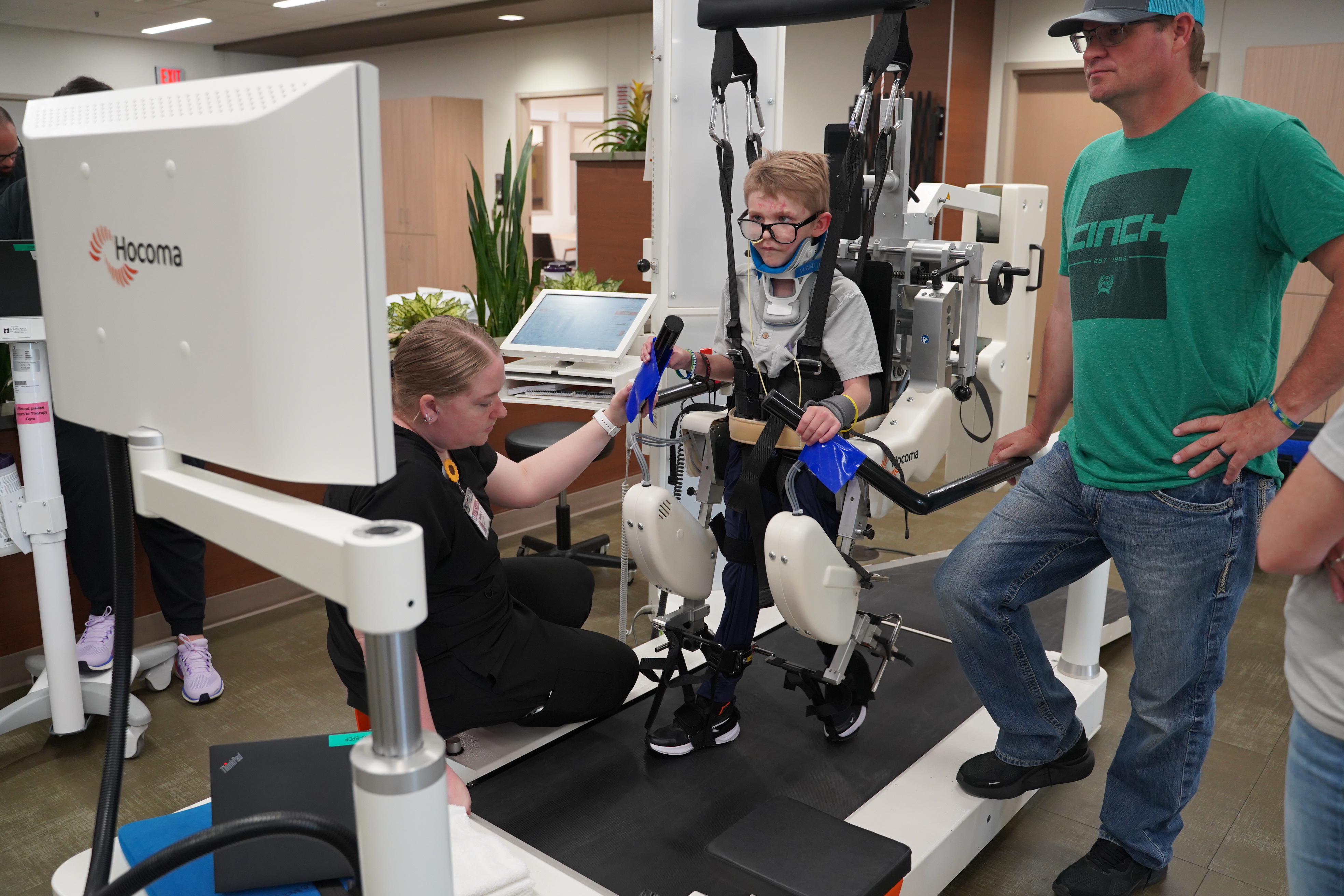
One of Cooper’s favorite activities was training on Madonna’s Lokomat robotic gait trainer. While many patients enjoy the built-in video game, Cooper turned it into a competition with himself.
“He really loved trying to beat his record every week,” Leversee said. “Trying to see how hard he could kick his legs to see how fast he could get the robot to run and collect all the coins.”
For Cooper, every new high score represented more than just a game. It was another sign of progress. But therapy wasn’t always focused on building strength. Sometimes, the best therapy doesn’t feel like therapy at all.
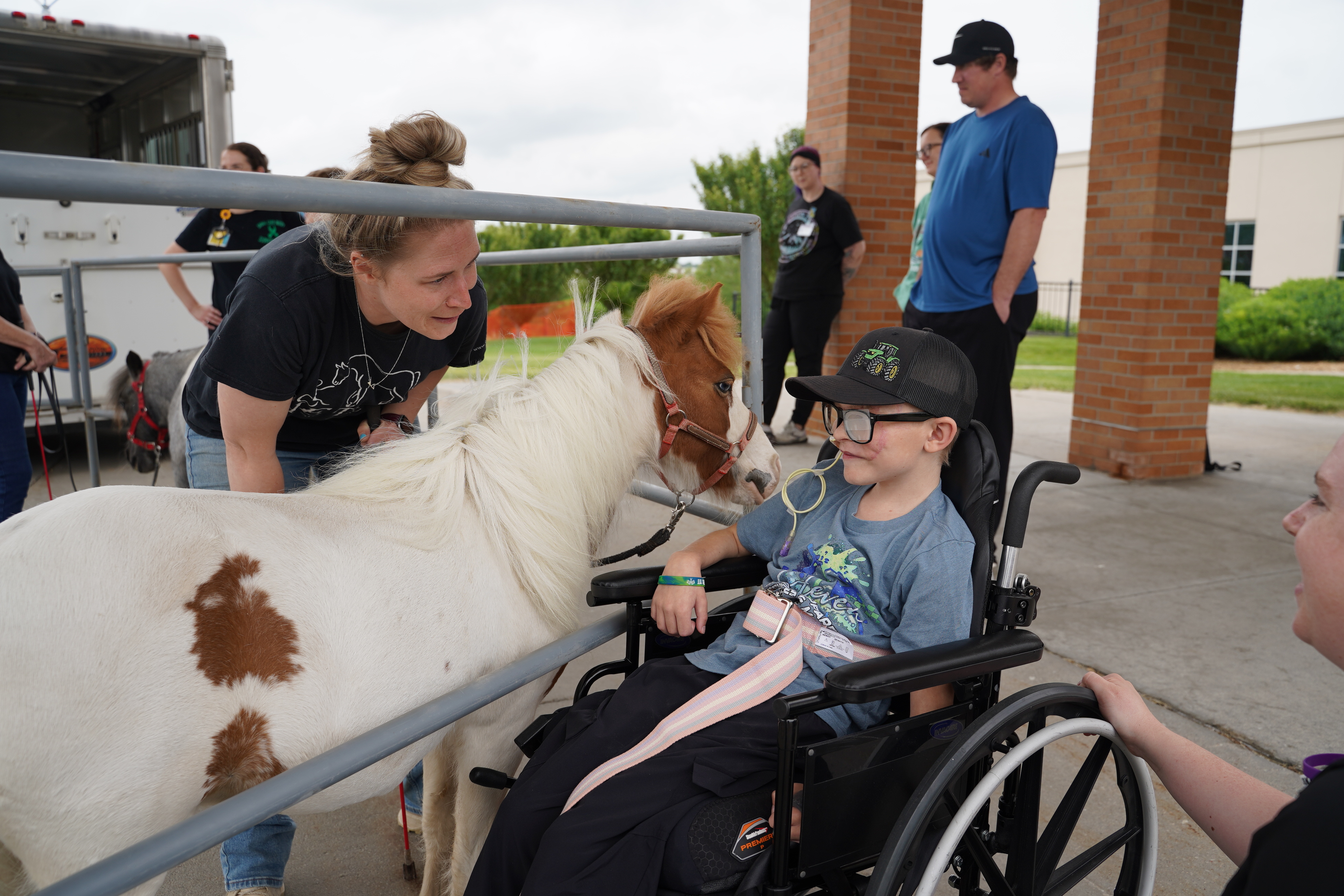
A visit from Heartland Equine Therapeutic Riding Academy (HETRA) mini horses brought a little bit of home to Cooper while he was hours away from his beloved farm animals.
“While we were with the horses, we were working on his sit to stands and just working on his standing tolerance,” Leversee said. “He just popped right out of that chair, stood right up and started petting the horses with the biggest smile on his face. We can do reps and sets of everything in therapy all day long but what’s meaningful is getting him back to doing the things that he enjoys doing, which is petting the horses and being around animals.”
As Cooper’s strength returned, so did his personality.
“Cooper is a jokester,” Cait Scott, MS, CCC-SLP, CBIS, Cooper’s speech-language pathologist, said. “When he was finally able to even get single words out, he was already telling jokes and being sarcastic.”
Cooper’s recovery wasn’t something he accomplished alone.
His family rarely left his side, encouraging him through difficult days while also knowing when to give him the space to process the challenges of rehab.
“His family was here a lot,” Alysa McKenny, OTR/L, CAPS, Cooper’s occupational therapist, said. “They were always encouraging him. They knew the right way to push him and when to step back and let him have a moment. They were also sources of entertainment, knowing how to make him laugh and brighten his spirits.”
With every milestone, Cooper moved closer to the place that motivated him from the very beginning.
“He’s determined to get home and get his life back,” Kelly said. “I think that’s what drives him, getting home back to the funny farm.”
By the time Cooper was discharged, he was walking with assistance, talking and independently driving his power wheelchair. With some practice, he felt comfortable navigating the uneven terrain of the farm.
“It was so good to see him get home,” Leversee said. “Seeing him moving around in his power chair, sitting side-by-side, doing what he loves and participating in all of the things back home that he loves doing in just a little bit different of a way.”
Looking back, Kelly is amazed by how far her son has come.
“He’s worked really, really hard and come a long way,” she said. “I know you’ve got a way to go, but you’ve come so far.”
Cooper’s advice for anyone facing their own challenge is simple.
“Work your hardest.”