
Two weeks after welcoming her daughter, Nicole Hoffman was adjusting to life as a mother of two when symptoms she thought had simple explanations quickly revealed something much more serious.
At first, Nicole thought the changes she was experiencing were related to childbirth.
“Two days after I had my daughter, I started getting this weird headache in my neck and if I lay down, it got better,” Nicole said. “I called the doctor and they said it’s an epidural headache.”
When the headache improved, Nicole thought she was moving past it. But soon, she began noticing tingling in her feet that she assumed was related to her C-section.
But the symptoms continued to progress.
“Numbness started creeping up my legs,” Nicole said. “And that’s when the paralysis hit me.”
An MRI revealed inflammation in Nicole’s spinal cord, which she thought would be a “simple fix.”.
But additional testing revealed a more complex diagnosis. A lumbar puncture showed significant abnormalities in her spinal fluid, and another MRI revealed lesions along her spinal cord closer to her brain.
“That’s when they discovered it was transverse myelitis,” Nicole said. “They were trying to find a reason as to why this happened. And unfortunately, they could not.”
Nicole’s condition quickly became life-threatening. While doctors worked to treat a severe infection, her family faced an impossible decision about balancing her immediate health with the risk of further neurological damage.
“My parents and my husband were left up to this decision of is she paralyzed or could I potentially die,” Nicole said.
After Nicole stabilized, her family began searching for the next step in her recovery: a rehabilitation program that could help her regain independence after a complex spinal cord injury.
Finding the right rehabilitation program
For Nicole, recovery meant finding a program with specialized experience to help her navigate an unpredictable journey.
As they explored rehabilitation options, Nicole’s familylearned about Madonna Rehabilitation Hospitals.
“We do this 365, 24/7, and we’ve been doing that for over 60 years,” Elizabeth White, RN, BSN, CRRN, CBIS, a Madonna clinical nurse liaison in Missouri and Kansas, said. “Getting to the right place and getting to the right people gives you the best outcomes possible to get back home.”
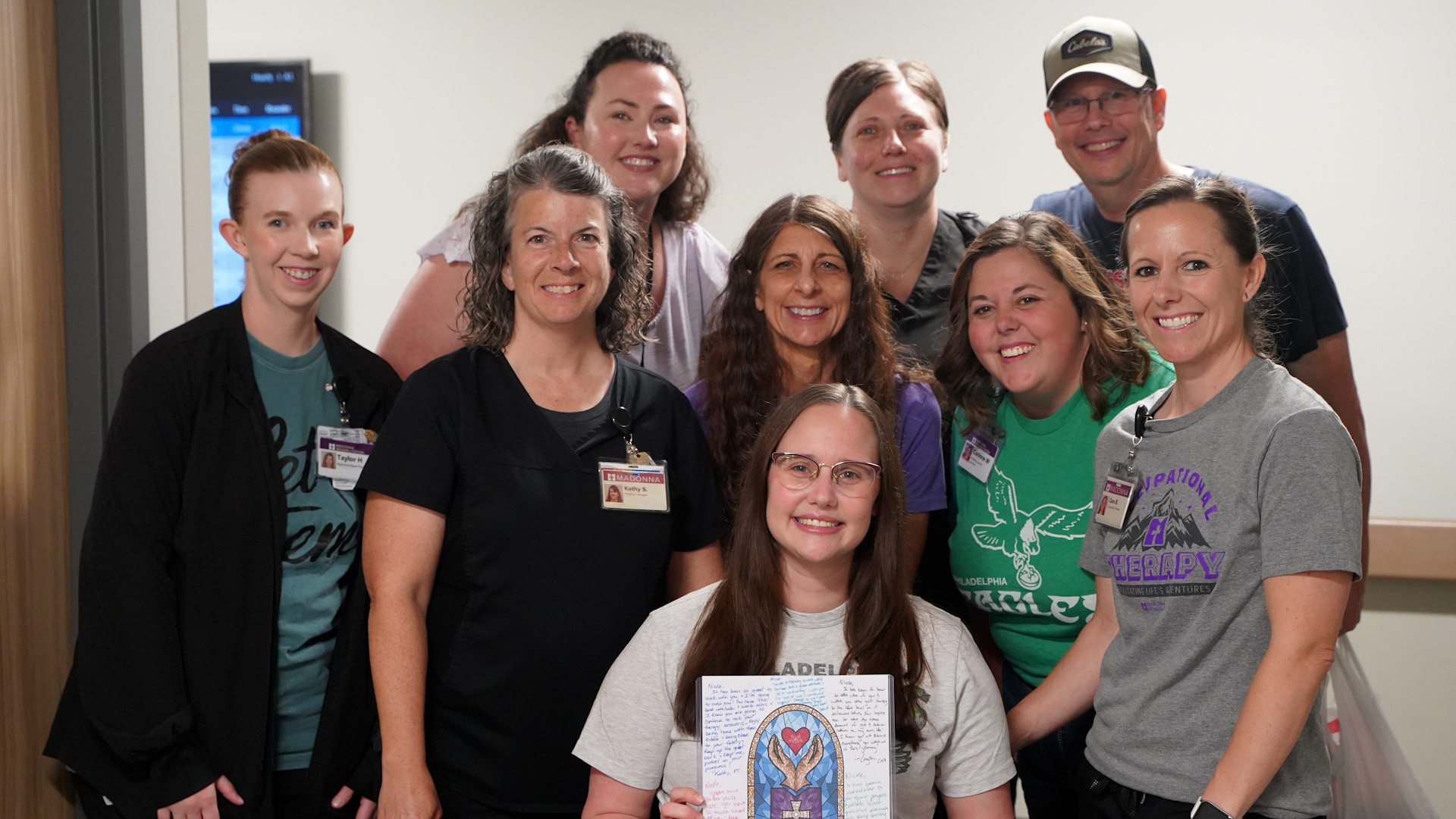
At Madonna, Nicole worked with a specialized interdisciplinary spinal cord rehabilitation team focused on helping her maximize independence, rebuild skills and return to the life she wanted.
“There’s nothing inpatient in Kansas City like this,” Nicole said. “Madonna is its own beast with how specialized they are.”
Starting over with the basics
Facing the reality of life with a spinal cord injury, Nicole arrived with no movement below her chest and many questions about what came next. She didn’t know how much movement she might regain, but she knew what she wanted to get back to.
“I couldn’t even wiggle a toe,” she said. “My sitting balance was terrible. I could barely get myself into the wheelchair. My goals were just to be as independent as possible for my kids, just to take care of myself and be able to take care of them.”
That goal shaped every part of Nicole’s rehabilitation.
A rehabilitation plan built around motherhood
Nicole’s rehabilitation team built her treatment plan around the daily activities that mattered most to her as a mom.
“Her outcome wasn’t going to define her,” Cara Bassinger, OTR/L, a Madonna occupational therapist, said. “She was going to return home to her kids and to her family and to her husband, no matter what that meant.”
In occupational therapy, Nicole focused on the skills she would need to navigate life at home with two young children after her spinal cord injury.
Using Madonna’s Independence Square, a simulated home and community therapy environment, she practiced reaching into a crib, preparing meals, doing laundry and adapting everyday routines to make them safer and more efficient.
“We would just practice accessing the kitchen and being able to prepare a sandwich and going over strategies of how that could be easier for her,” Bassinger said. “Because the last thing she wanted was that to take more time out of her day, to take away from her kids.”
Those moments helped Nicole rebuild not only her skills, but her confidence that she could continue being the mother her family needed.
“She was able to cook for herself, change diapers, take care of her kids to the level that she felt like she needed to and do all those motherly things that we have to do on a daily basis,” Bassinger said.
For Nicole, those goals remained the motivation behind every therapy session.
“Just talking about her kids just would bring a big smile to her face, and that would just spark each and every session, even if it was hard,” Bassinger said. “That’s what she always came back knowing that she’s doing this for them and for herself, too. But she wants to be there for her kids and her husband.”
Nicole’s therapy started with rebuilding independence in everyday moments, then progressed toward bigger goals as her strength and movement returned.
Rebuilding movement, one step at a time
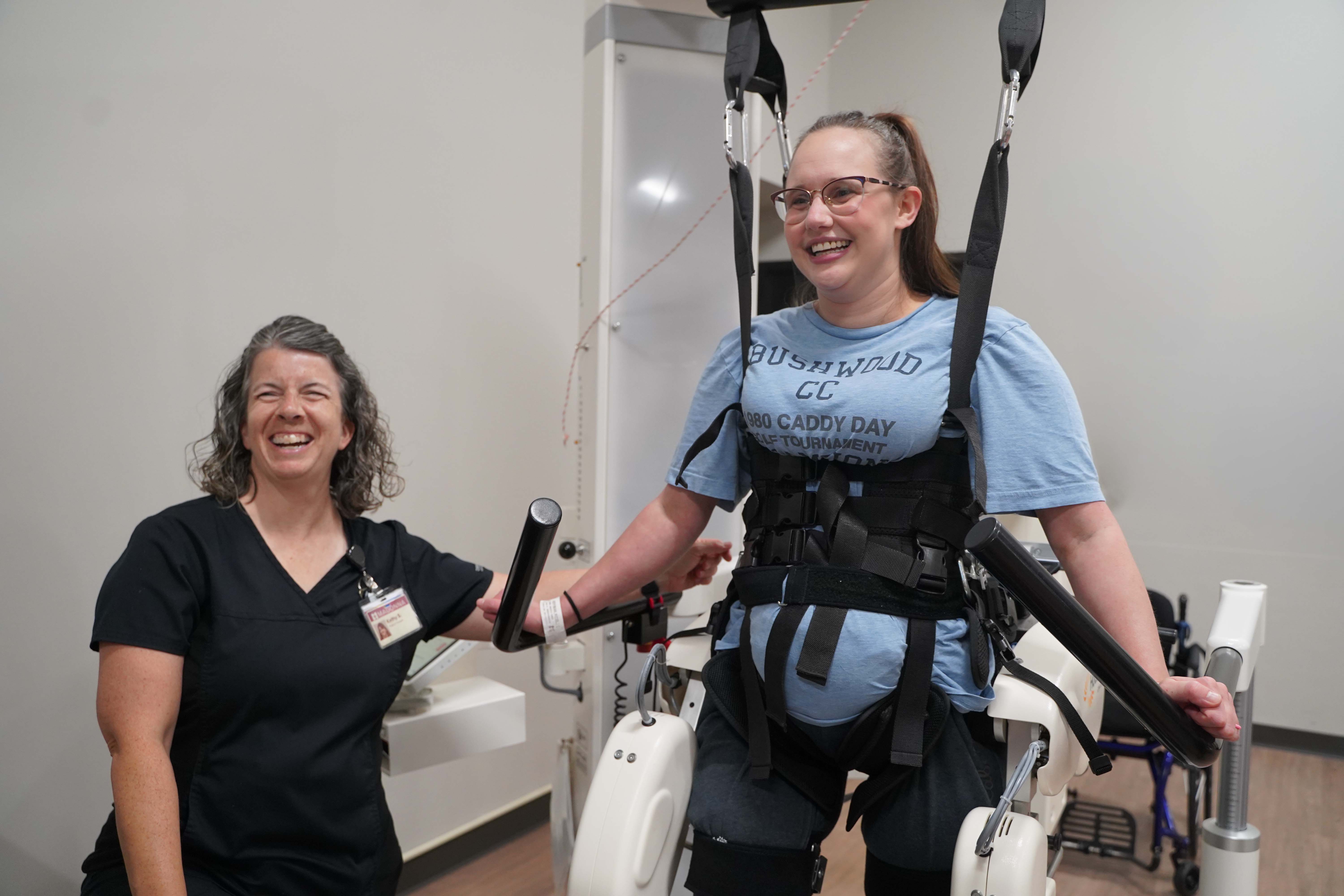
While occupational therapy focused on helping Nicole regain independence in daily life, physical therapy focused on rebuilding strength, mobility and control after her spinal cord injury, and her commitment to recovery quickly stood out to her team.
“She just came in here with an attitude that she was going to do the best she could do and work as hard as she could,” Kathy Sieves, PT, NCS, a Madonna physical therapist, said. “She wanted to be independent. She said that from day one.”
Her interdisciplinary team focused on building on even the smallest signs of progress, helping Nicole turn early movement into functional gains.
“Initially, it was just little trace activation of those muscles,” Sievers said. “Little flicker here and there. Sometimes inconsistent.”
As Nicole worked to reconnect her brain and body, therapy focused on helping her rediscover movement one step at a time. Early in her recovery, she used specialized technology, including the Lokomat robotic gait trainer, to guide her legs through a walking pattern while providing the repetition needed to rebuild movement. As her strength and control improved, she progressed to body-weight support treadmill training, allowing her to practice taking steps with less support.
Those early gains continued to build throughout her stay at Madonna.
“By the time she left, she definitely had activation in all muscle groups in her legs,” Sievers said. “She was working on the strengthening piece of it and trying to get them strong enough to be stable, to stand and to take steps.”
Because transverse myelitis affects each person differently, recovery can vary from one patient to another.
“Not knowing the exact cause of the transverse myelitis makes it a little bit trickier to predict because some people get movement back, like Nicole did, and other people, they don’t change at all,” Sievers said.
For Nicole, the progress she made through therapy changed what she believed was possible.
“I’ve been able to regain a lot below my level of injury, which I never thought I would be able to do,” Nicole said.
She began working on gait training, focusing on the possibility of walking again.
“I feel like my brain is starting to piece together the walking motion,” Nicole said. “The more repetitive movements you get, the better the brain can piece together what’s supposed to be working in your legs.”
A goal measured in moments
For Nicole, every milestone brings her closer to the moments she has been working toward since the beginning: being there for her children.
Even after spending so much time away from her family during her recovery, Nicole’s motivation has remained the same: returning home and being present for the everyday moments of motherhood.
“And I’m hoping that just being around them every single night, getting to read a story before bedtime, it’s just going to be an extra drive and motivator in therapy,” she said.
Now, she is working toward a moment that would bring her journey full circle as a mom.
“My daughter and I are going to learn how to walk at the same time,” Nicole said. “My goal is to be able to walk by her first birthday so we can kind of go through it together.”