
For 19-year-old Levi Maassen, recovery after an ATV accident caused a life-changing brain injury came down to two very specific goals: doing a pushup and eating his favorite meal at Culver’s. When Levi arrived at Madonna Rehabilitation Hospitals, both seemed far out of reach.
“They told us the first day of his injury that with brain injuries, there’s a lot of ups and downs and we’ve seen a lot of them,” Lora Maassen, Levi’s mom, said.
Levi was in a serious ATV crash on April 21. After spending a month at Avera McKennan Hospital in Sioux Falls, he was weak. He struggled to hold his head up and needed significant assistance with mobility.
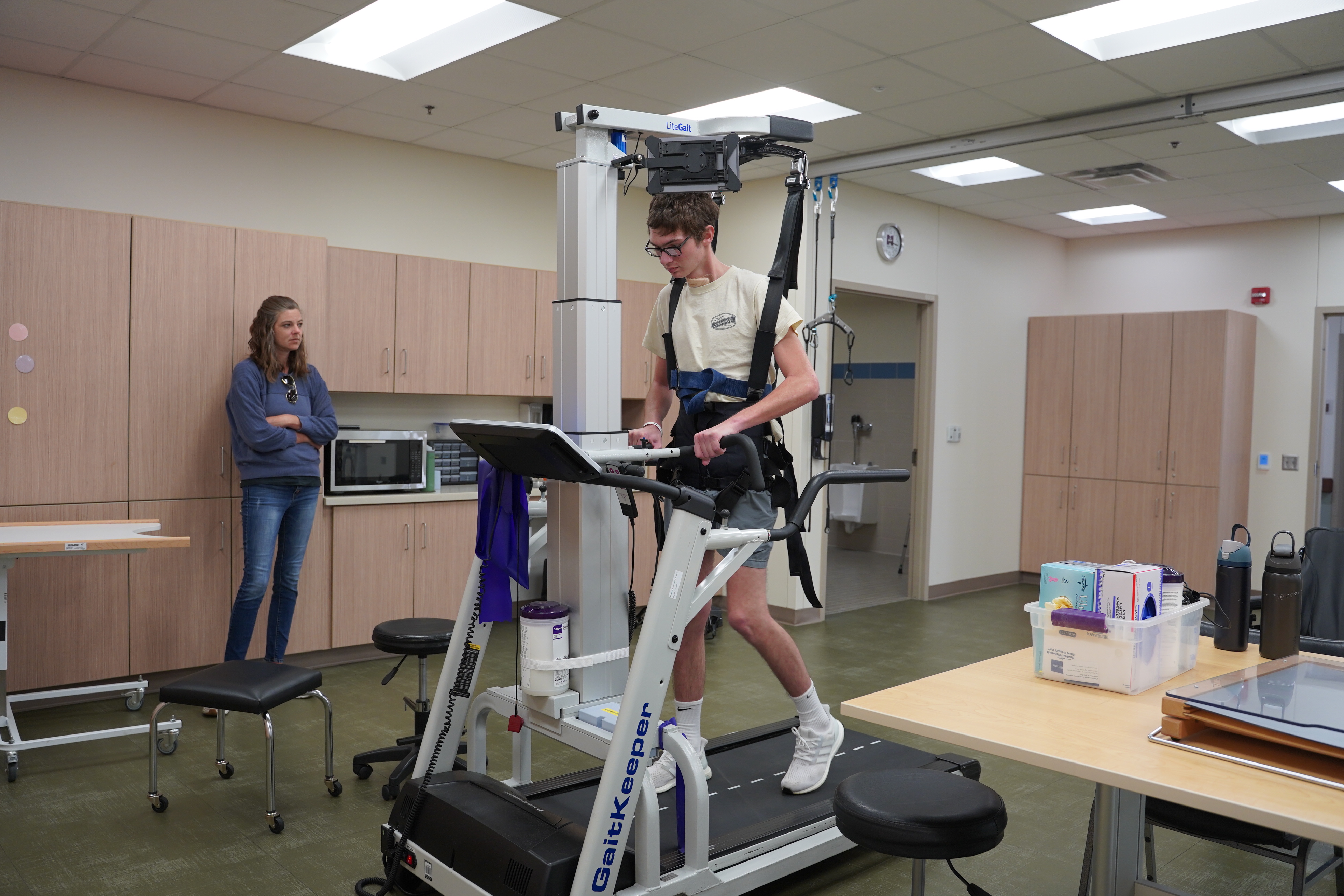
“When I first met Levi, he had several different deficits that we noticed right away,” Drew Burggraff, PT, DPT, CBIS, Levi’s physical therapist, said. “He had generalized weakness. He had very poor endurance. He had ataxia, which is a coordination impairment, and then he also had several balance impairments, and all of this affected his overall mobility.”
Dizziness presented another obstacle. Early in his rehabilitation, Levi needed frequent rest breaks and wasn’t able to tolerate the intensity of activity his therapists wanted to provide. Getting him to that point required more than physical therapy alone.
“He saw one of our vestibular therapists to look at that vestibular system,” Burggraff said. “He was in daily vision groups because our visual and vestibular systems kind of work hand in hand there. The physicians even played a role by prescribing him medications that would help kind of manage those systems, so he was able to tolerate doing more in therapies.”
As Levi’s symptoms improved, his therapists could begin challenging him more. Throughout his physical therapy, Levi used specialized rehabilitation technology, including the LiteGait bodyweight support system, Andago gait trainer, Madonna ICARE by SportsArt elliptical and Proprio balance machine. The wide range of specialized technology allowed therapists to adjust the amount of support and challenge Levi as his abilities changed.
“We were able to take away his upper extremity support so he had to challenge his balance system a little bit more that way,” Burggraff said. “We added in weights for his ankles. We incorporated multi-directional stepping. We were able to have him step onto or over objects.”
The goal wasn’t simply to help Levi walk inside the hospital. It was to prepare him to move through the world again.
Levi’s occupational therapy focused on rebuilding strength and control in his upper body. When he first arrived, his arms were especially weak. His occupational therapist, Abby McDonald, MOT, OTR/L, CBIS, began with functional electrical stimulation before progressing him to the ArmeoSpring exoskeleton.
“He really quickly surpassed the need for the FES bike and then we started doing the Armeo because that exoskeleton helped provide against gravity support so he could achieve more things,” McDonald said.
Levi progressed quickly and kept his eyes on the prize, no matter how difficult achieving his goals sounded.
“Day one, he couldn’t move his shoulders much, and by the end of his time here, his goal was to do a push up and he was doing pushups,” McDonald said.
But rebuilding strength was only part of Levi’s recovery. He also needed to regain the ability to eat safely.
“The first big goal we had for him is we wanted him to eat,” said Claire Dowling, MS, CCC-SLP, CBIS, a Madonna speech-language pathologist. “He’s a nineteen-year-old boy, so that’s one of his main hobbies is eating and he made it very clear that he wanted to eat.”
Speech therapy included swallowing evaluations, dysphagia exercises and specialized technology. Levi was one of the first patients to pilot Madonna’s Synchrony device, which uses biofeedback to give patients a visual representation of their swallowing effort.
“Instead of us just saying, ‘We want you to give us a big, hard swallow,’ that technology allows the patient to actually see on a graph that visual representation of how they’re swallowing,” Dowling said.
Slowly, Levi’s swallow became safer and his diet progressed.
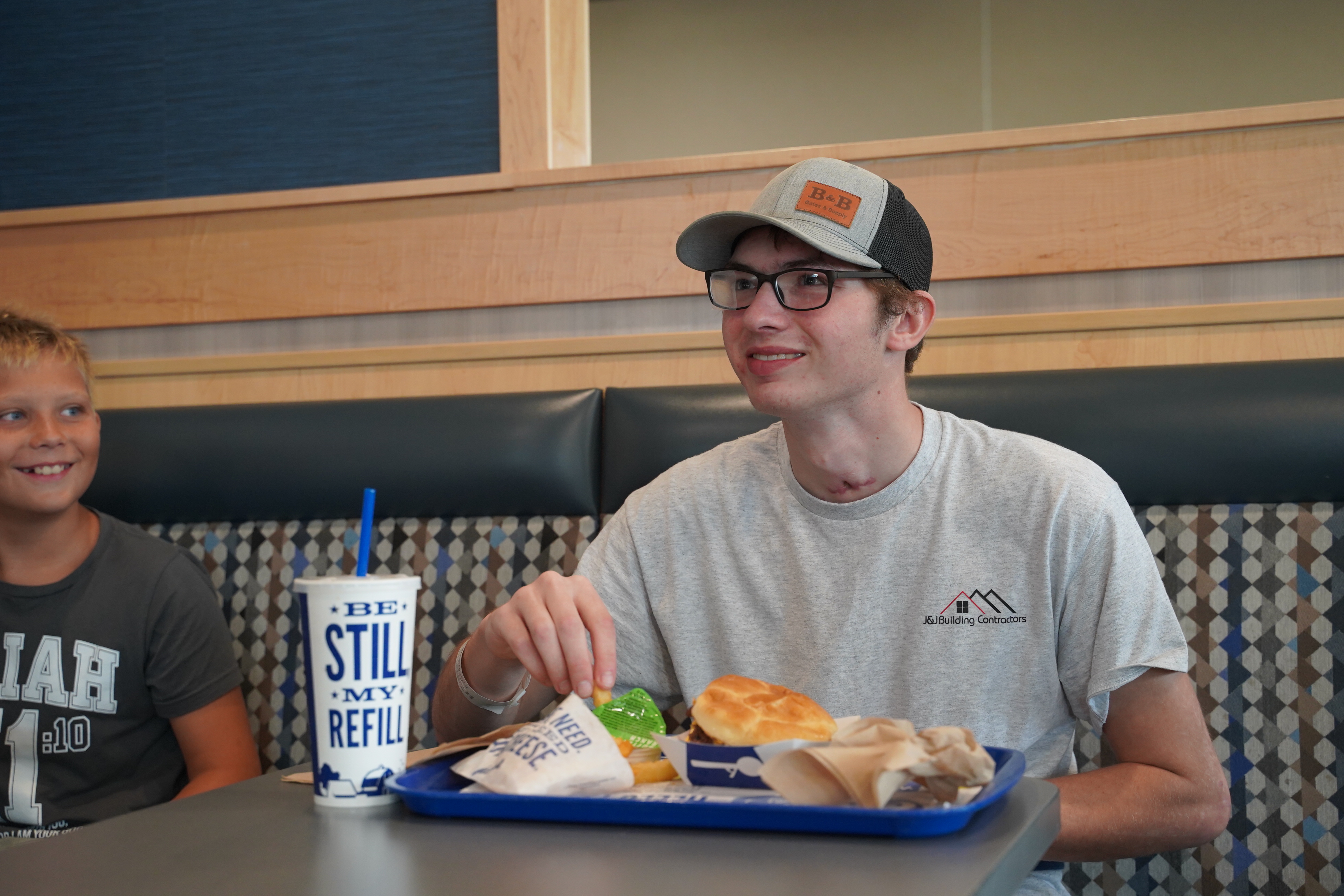
“Our final big hurrah was that outing to Culver’s where he was able to finally get his butter burger that he’s used to having three days a week,” Dowling said. “When I was able to go in there and surprise him and tell him that his diet was upgraded, just to see that huge grin on his face, that was definitely worth it. All the hard work that we put in over several weeks was very worth it.”
The Culver’s outing became a celebration of how far Levi had come. He could walk into the restaurant, order his own meal and eat it. For McDonald, it was a moment she won’t soon forget.
“It was really cool to be part of that,” she said. “The fact that his whole family got to be there, we all got to watch him order, which he was very quick to order exactly what he wants every time, and having him take that first bite.”
Levi’s progress wasn’t simply the result of technology or therapy.
“Levi was just incredibly motivated himself,” Burggraff said. “He wanted to return to home. He wanted to get back to his previous lifestyle.”
A strong family support system helped keep Levi focused and continued his therapy even after his sessions were over for the day.
“His parents were with him virtually for every session that he was in,” Burggraff said. “They were able to see in person what we were doing in our therapy sessions and be able to take those cues, those exercises and reinforce those outside of our therapy sessions as well.”
The combination of Levi’s determination, his family’s support and an intensive, multidisciplinary rehabilitation program helped turn two very personal goals into milestones he could achieve.
A pushup. A Culver’s Double Deluxe.
Two things Levi wanted back and two reminders of just how far he’d come.