If you ask 9-year-old Jude from Gretna, Nebraska, about months of intensive rehabilitation, he’ll probably shrug and tell you it was “light work, no reaction.” That answer usually gets a laugh, but it’s also a reminder of something his family never wanted to lose during his recovery: his personality.
Today, Jude is talking about football, cracking jokes and keeping everyone around him on their toes. Just a few months ago, after a traumatic brain injury in June, his future was much less certain. Jude came to Madonna Rehabilitation Hospitals’ specialized pediatric rehabilitation program from Children’s Nebraska once he was medically stable, but he was still very weak and unaware of his surroundings.
“When we first got here, he could open his eyes, very minimally follow some commands but not many,” Marissa, Jude’s mom, said. “We have pictures of the therapists actually having to hold his head up for him because he didn’t even have the strength to hold his head up.”
For Jude’s physician-led care team at Madonna Rehabilitation Hospitals, rehabilitation began with helping him emerge from a minimally conscious state and rebuild the most basic skills. But it didn’t take long to realize Jude’s recovery would require more than traditional exercises alone.
Turning Therapy Into Something Worth Showing Up For
Sports have always been a big part of Jude’s life. His therapists quickly learned that if an activity involved football, competition or a challenge, they had his full attention.
“We threw the football a lot,” Alysa McKenny, OTR/L, CAPS, Jude’s occupational therapist, said. “With him being a big sports kid, that kind of was a motivation throughout his whole journey.”
Physical therapist Bailey Leversee echoed that sentiment. She says she and Jude played football at least once every single day during his therapy sessions. That approach reflects one of the hallmarks of pediatric rehabilitation at Madonna: building treatment plans around what matters most to each child.
“When Jude first came and he wasn’t able to do too much, we tried really hard to just motivate him for any interaction using sports and games,” McKenny said.
McKenny remembers the first time Jude was really engaged with therapy. A little finger basketball game was one of the first toys he was able to operate, moving one index finger to make the game work.
What started with simple activities gradually evolved into higher-level challenges as Jude continued making progress.
“Every single day he showed us something new,” Leversee said.
Recovery That Kept Changing With Him
One of the biggest challenges in Jude’s recovery wasn’t setting goals. It was keeping up with how quickly he achieved them.
“When he came in, he was still emerging, but we knew he was going to make great progress,” Leversee said. “Every single week, I had to make large changes to his goals because of how fast his progress was.”
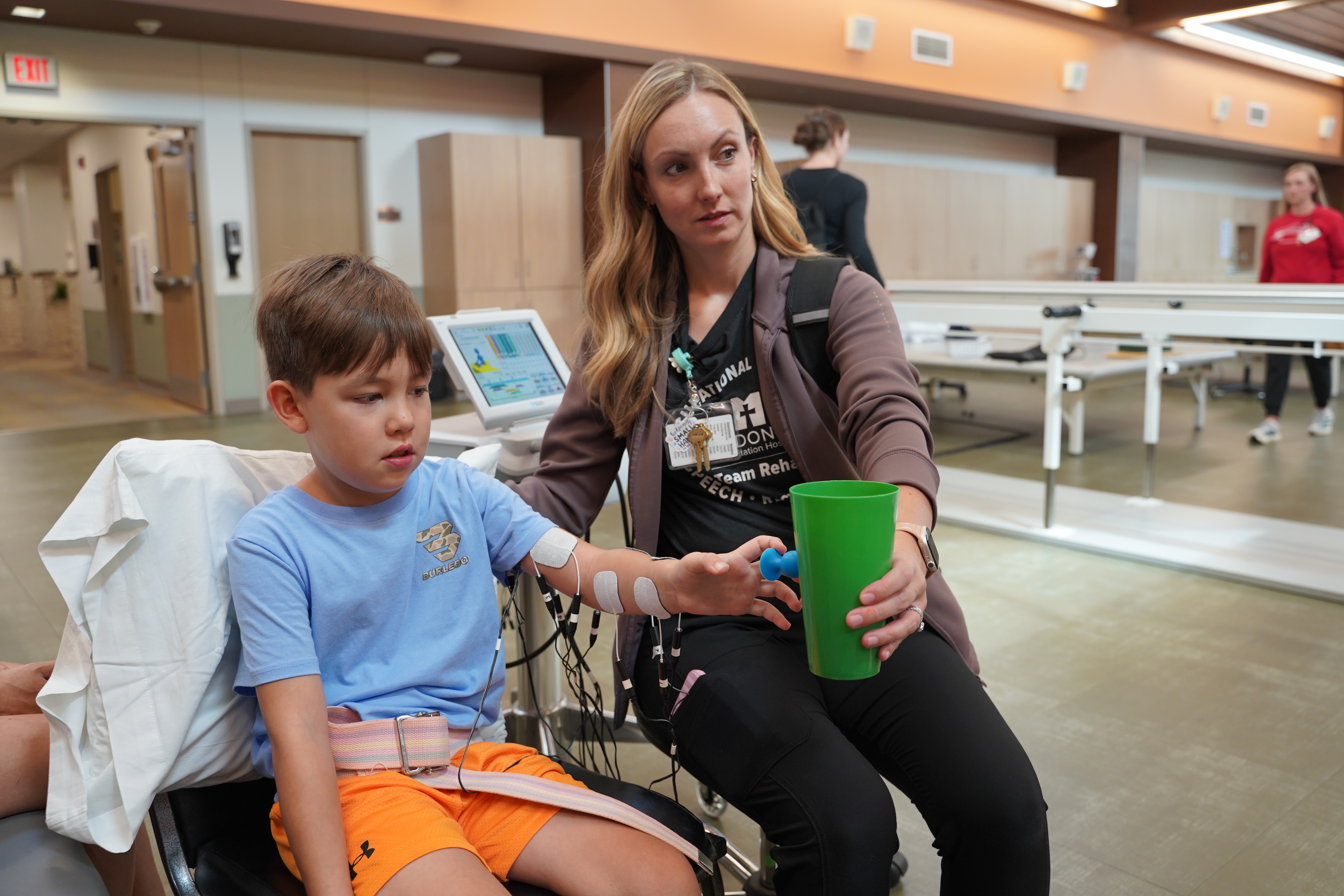
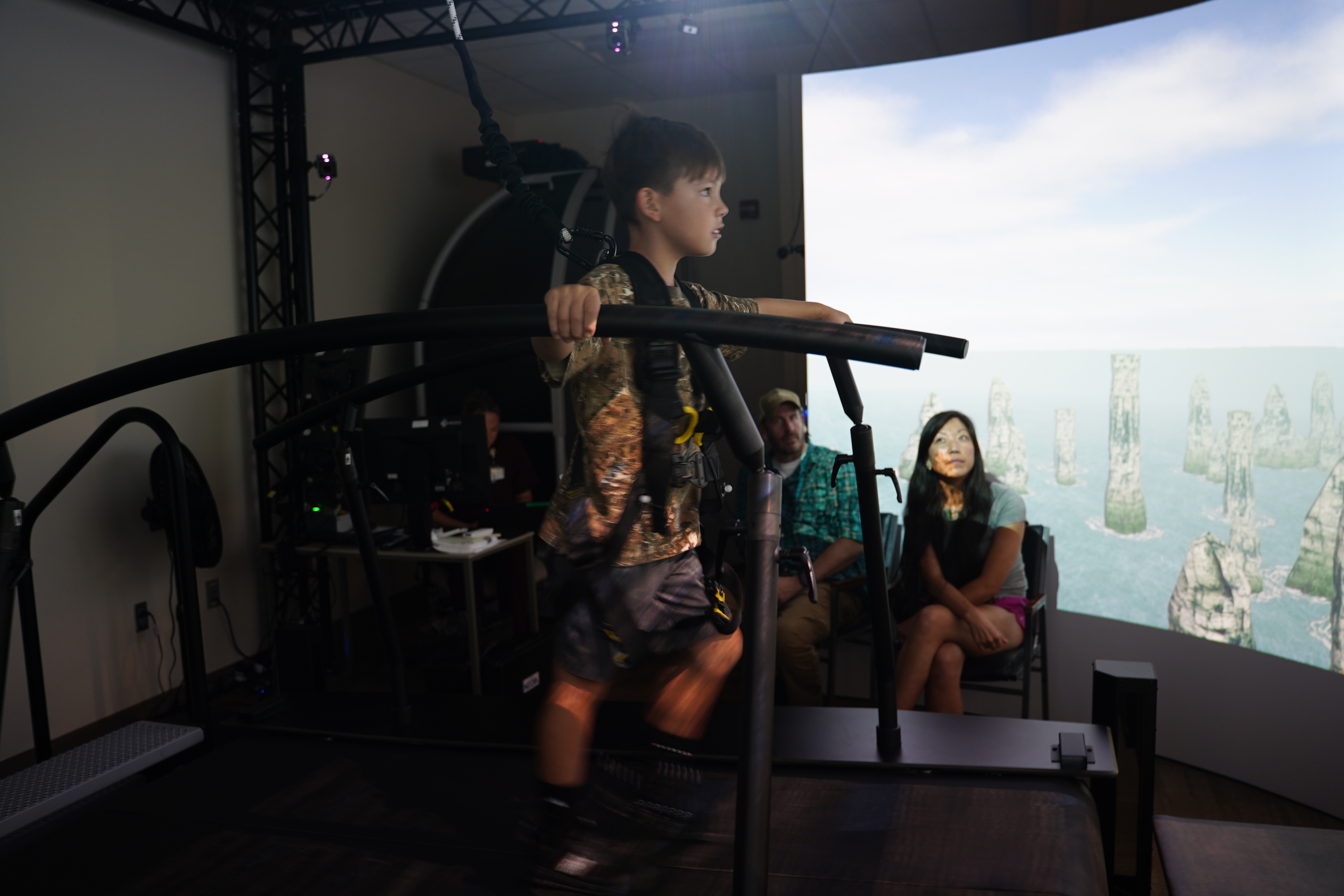
To support his recovery, Madonna’s team incorporated advanced rehabilitation technology, including functional electrical stimulation, bodyweight support and gait training systems designed to improve strength, mobility and coordination.
From the Lokomat robotic gait trainer, Jude quickly progressed to walking with minimal bodyweight support using the LiteGait, first to walk down the halls, and then to run.
On the functional electrical stimulation (FES) bike, Jude set a goal of riding six miles.
“He crushed it,” McKenny said. “It took to the very last day, but he did it and he was so excited.”
Bringing Jiu Jitsu Into Rehabilitation
For many patients, therapy sessions focus on rebuilding everyday skills. For Jude, that meant his favorite sports.
“Jiu jitsu with Isaac because I love jiu jitsu,” Jude said when asked about his favorite part of therapy.
Occupational therapist Isaac Hiebert, OTD, OTR/L, also trains and coaches jiu jitsu, so he used the sport to target balance, coordination and body awareness.
“Not only were we working on skills that were applicable to actual jiu jitsu, but therapy as well,” Hiebert said. “There’s a lot of kinesthetic awareness that happens, tons of floor transfers, getting up and down off the floor, working on our upper extremity and lower extremity strength [and] coordination.”
The sessions gave Jude an opportunity to work toward real-world goals while doing something he genuinely enjoyed.
“When he first started that, he needed quite a bit of help to get up off the floor,” Hiebert said. “By our fourth session, he was just popping right up on his own.”
Back to School
Even while working through hours of therapy each day, Jude was still a student with homework to do.
Through Madonna’s Therapeutic Learning Center, teachers collaborated with Jude’s school to gather classwork, coordinate assignments and help him continue learning throughout his rehabilitation stay. He especially excelled in math, his favorite subject. Games like multiplication wars challenged Jude’s cognitive skills while still making learning fun and ensuring he would be able to return to the classroom when his inpatient therapy was complete.
Aquatic Therapy and a Broncos-Inspired Teammate
Aquatic therapy in Madonna’s warm-water therapy pool became another important part of Jude’s rehabilitation journey.
“When Jude first came to the pool, we were working on more just sitting to standing and then starting to build into walking,” said Ben Dorsey, PT, DPT, Jude’s aquatic physical therapist, said.
The buoyancy of the water allowed Jude to practice movements in a reduced-weight environment while developing strength, confidence and endurance.
To keep him engaged, therapy often looked more like play than rehabilitation.
Jude’s care team incorporated games, basketball, football and stepping challenges into the pool. One of Jude’s favorite activities involved a giant inflatable turtle.
“We have this big inflatable turtle that he named Bo Nix because he’s a big Broncos fan,” Dorsey said.
What began with substantial assistance eventually led to major gains in mobility.
“By the end of the sessions, he was walking down the stairs with just making sure somebody was standing by for balance,” Dorsey said.
Aquatic Therapy and a Broncos-Inspired Teammate
Jude’s rehabilitation included countless physical milestones, including learning to move, learning to communicate, learning to eat and learning to walk. But for his family, the greatest success wasn’t measured in steps or therapy goals.
“That was our biggest answer to prayer,” Marissa said. “It was the thing that we wanted the most, that just his personality and his spiciness is still intact.”
Jude quickly interrupted.
“Hey! Don’t say that I’m spicy!”
It was clear that Jude’s sense of humor never disappeared.
“He was always joking, always laughing,” McKenny said. “He just always had a smile on his face.”
In fact, one thing nearly every therapist noticed was Jude’s ability to connect with people.
“When we would walk down the hall with him in between therapies, it would take us an extra five minutes because he waved at everyone,” McKenny said. “Everyone knew him.”
“Don’t Quit”
Today, Jude is back to spending time with friends, playing sports and continuing his recovery journey in Madonna’s Rehabilitation Day program. When asked what he would tell another child facing a difficult rehabilitation journey, his message is simple.
“I’d tell them the line of don’t quit,” he said.
Marissa said that mindset carried him through every challenge he faced.
“The entire time we were here, he never quit,” she said. “Even when something was difficult for him, he wouldn’t give up and that helped him get to where he is today.”
Jude’s summary of his recovery is much shorter.
“I didn’t quit one bit.”
And if you ask him what made him so successful?
“I am the greatest of all time,” he said, “not to brag.”