Every time therapy became difficult, Kaden Hill had a response ready.
“I’ve been through a lot,” he’d joke.
His Madonna therapists would laugh. But they also knew it was true.
“He always put a smile on his face and worked hard and brought humor even when we were making him do something challenging or painful,” Alysa Jensen, OTD, OTR/L, a Madonna occupational therapist, said. “He would jokingly tell us, ‘I’ve been through a lot,’ but really he had been through a lot. His body had been through a lot.”
While working on a highway construction project on July 28, the electrician apprentice from Sedgwick, Kansas, was digging up large light poles when a truck entered the work zone at highway speed.
“There was a dually truck with a trailer that ran into my traffic cone, then clipped a truck and then swerved into the guardrail and rolled straight into me,” Kaden said. “I flew over 30 feet and landed and the guy beside me passed away.”
Over the next week, Kaden underwent 10 surgeries at Wesley Medical Center in Wichita, Kansas.
The injuries were extensive. He fractured nearly all of his ribs, requiring five rib plates. Both arms sustained severe injuries. He fractured both shoulder blades and sustained fractures to his neck, back and face. He fractured his knee, tore his MCL and meniscus and both lungs were punctured. His liver was severely damaged, and his spleen had to be removed. He also sustained a major concussion.
One particularly severe laceration stretched from the front of his armpit through his back.
“They said whatever hit me in that area was a centimeter away from hitting my main artery,” Kaden said.
When the 23-year-old arrived at Madonna’s Specialty Hospital, rehabilitation wasn’t the immediate priority. Physicians, nurses, therapists and specialists were working together to manage Kaden’s pain, giving him time to heal and preparing him for the next phase of recovery.
“The specialty hospital really focuses on that medical stability,” Andrea Kremeier, M.S. CCC-SLP, CBIS, a Madonna speech-language pathologist, said. “Kaden was being seen by the wound care team. He needed more intensive medical management. He still needed X-rays to figure out all the broken pieces. He would not have been able to participate in the three hours of therapy required (in the rehabilitation hospital), not to the best of his abilities. He needed more time to heal.”
But recovery wasn’t put on hold while Kaden healed.
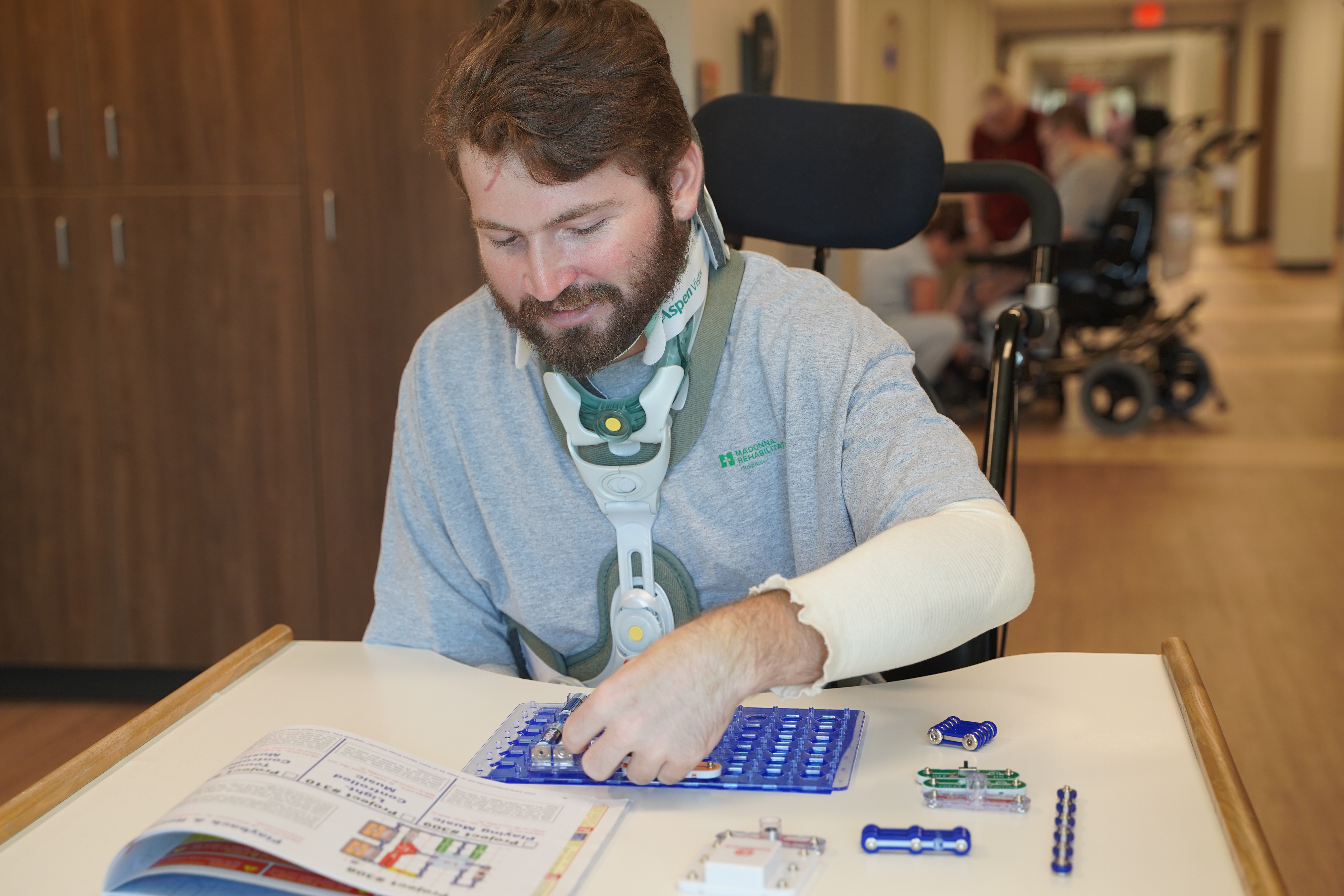
Before the work-related accident, Kaden was working as a journeyman electrician apprentice. While his body recovered, Madonna’s interdisciplinary team helped him continue preparing for that future through snap circuit problem-solving puzzles and studying for the licensing exam he had been preparing to take.
“We really wanted to get him back to that mental standpoint to be ready to go back to work,” Kremeier said. “He couldn’t do the traditional work re-entry because his body couldn’t do those demands yet, but his brain was ready for it. One of my favorite parts of working with Kaden is trying to help him be who he was within the confines that he had at the time.”
As Kaden’s pain became more manageable and his injuries continued to heal, he progressed to Madonna’s Rehabilitation Hospital where the focus shifted from medical recovery to rebuilding strength, movement and independence.
After weeks of immobility, progress often came through milestones many people take for granted.
“Initially, we were working lots of stretching, range of motion, getting to the point where he could trust that his arm was able to move again,” Jensen said. “A lot of the pain came from the fact that it was scary because he’d been still for so long.”
Simple tasks gradually became possible again.
“The first time I touched my face with my left arm, all of a sudden now I was touching the back of my head within a week,” Kaden said.
Those moments helped build confidence, encouraging Kaden to keep pushing through the challenging days of recovery.
“Kaden was a fighter,” Jensen said. “Other than not being able to physically walk, he was bound and determined to be independent regardless.”
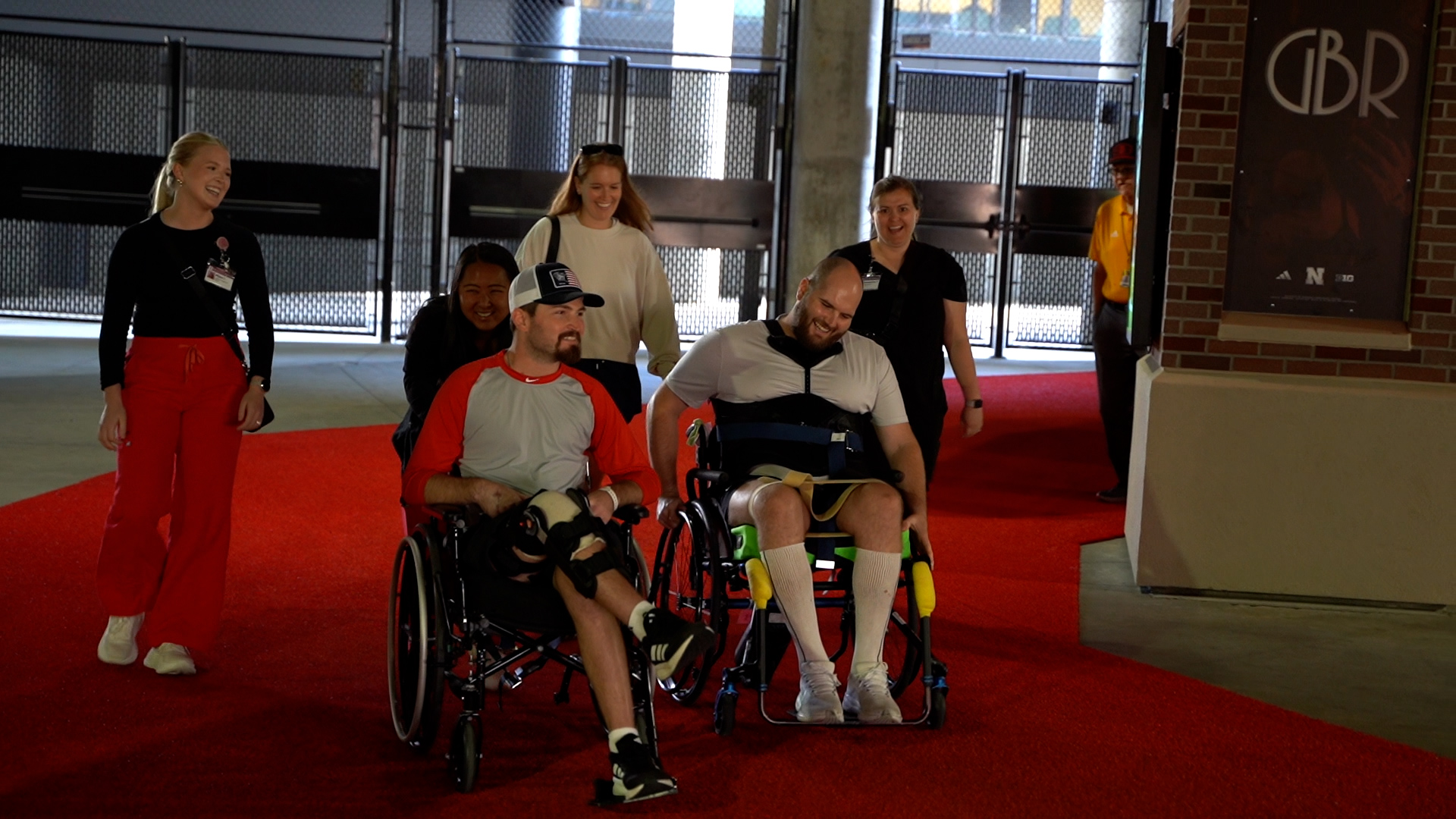
As therapy progressed, community outings helped Kaden reconnect with activities and experiences he had missed during months of hospitalization.
“Being in the hospital is hard,” Jensen said. “So, getting Kaden back into the community was important. Not just for getting him back to his life and the things he enjoys doing, but being able to go to dinner with your family or explore new places is so great for your mental health and the ability to keep pushing, even when it’s challenging.”
After nine weeks at Madonna, Kaden finally reached one of the goals he set from the beginning.
“I am walking like an old man,” he joked, “but I’m walking.”
For the therapists who watched his journey unfold, that progress represented far more than physical recovery. It was the result of months of healing, perseverance and a never-stop moving forward mentality, even when his body demanded patience. And through it all, he never lost his sense of humor.
“I’ve been through a lot,” he would tell his therapists.
Nobody understood that better than the people who helped him recover.
And nobody was more thankful than Kaden himself.
“It means the world to me what this place has done,” he said.