
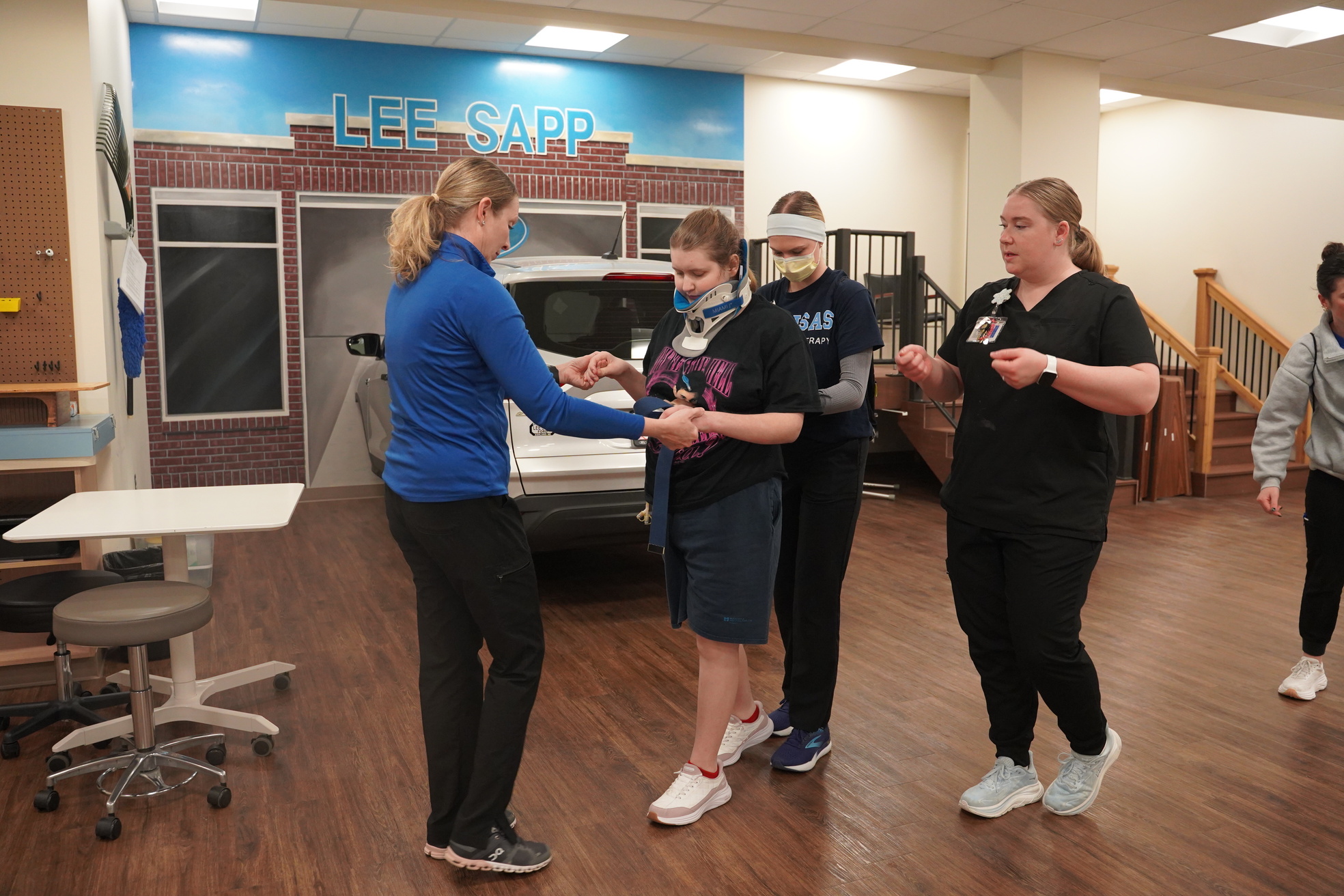
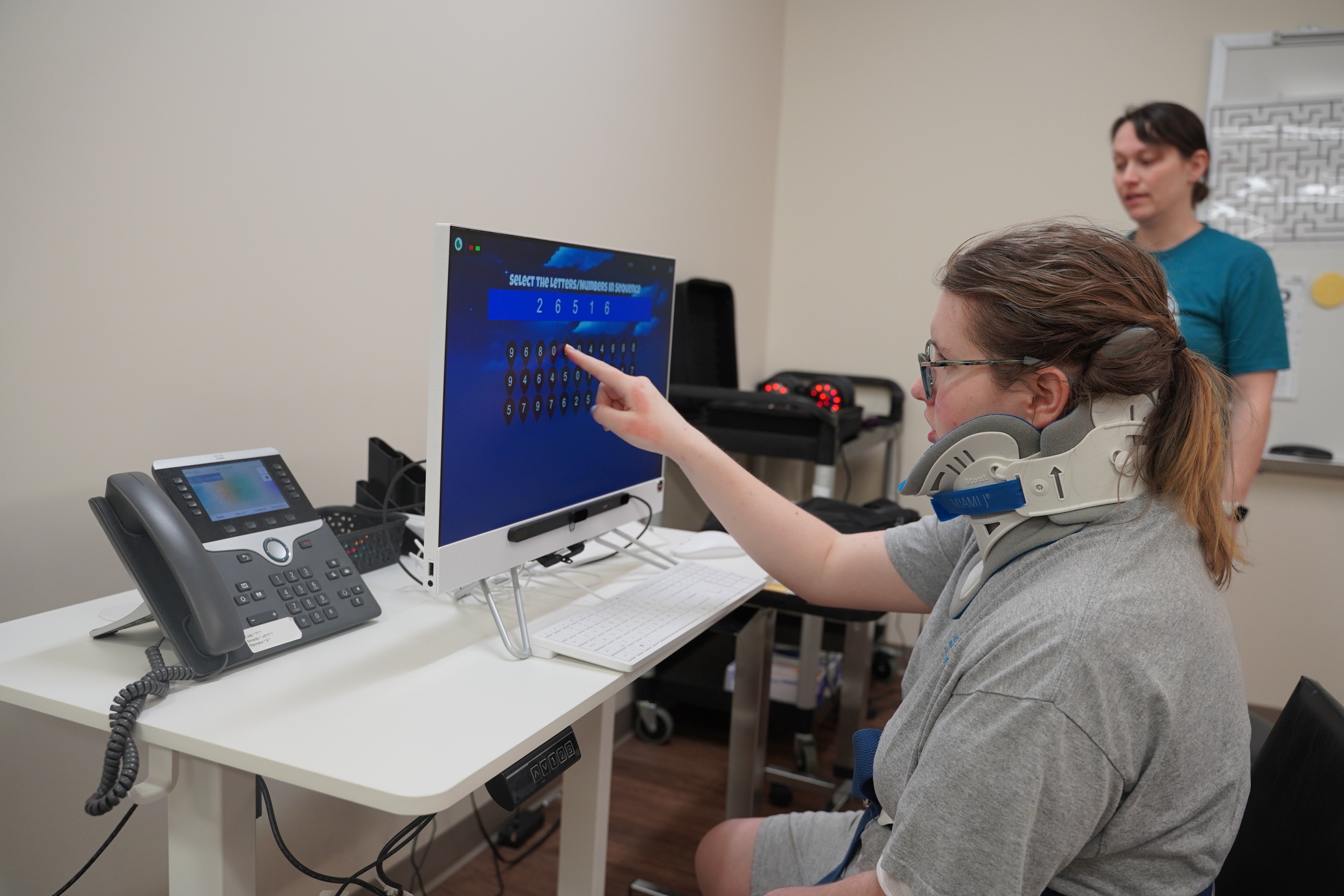
High school and college are seasons of transition. Teenagers look toward the future while building the social, emotional and cognitive skills they’ll need for what comes next. Madonna Rehabilitation Hospitals’ specialized pediatric program helps patients and their families navigate that pivotal stage while recovering from serious injury or illness.
For 19-year-old Meredith Breinig, life revolved around college classes, caring for her farm animals and bowling with friends, until a November car crash changed everything. She sustained multiple broken bones and a traumatic brain injury that left her in a minimally conscious state. She came to Madonna’s pediatric disorders of consciousness program determined to reclaim her independence.
“My brain was super duper angry waking up, and that’s fair because I suffered a traumatic brain injury,” Meredith said. “I was very combative and I couldn’t really do anything by myself.”
When she first arrived, Meredith could not hold up her head independently. She required a ventilator to breathe and maximum assistance for all activities of daily living. Even as she began emerging into full consciousness, her care team saw something special within her.
“I just thought she’s going to walk out of here and I don’t know what it was because she wasn’t following any commands, but I could just see that she had something within her that just was going to give her that extra drive,” Bailey Leversee, PT, DPT, CBIS, Meredith’s physical therapist, said.
With patients experiencing a disorder of consciousness, therapy begins slowly.
“We were working on just sustained attention for 30 seconds,” Rachel Stonacek, MS, CCC-SLP, CBIS, Meredith’s speech-language pathologist, said. “I would ask one or two questions and then I would have to give her a break because that would get her pretty worked up.”
Meredith also struggled with confusion about where she was and who people were as they entered her room.
“It was really important that I helped her become oriented to where she was, that she was safe, and get to know us and build that rapport and trust during that time of her recovery,” Stonacek said.
As the agitation and confusion subsided, Meredith’s personality resurfaced. She was social, funny and unwaveringly positive.
“Her go-to is always, ‘And that’s OK,’” Stonacek said. “‘This is hard, but that’s OK.’ And she would always talk herself through that. She would acknowledge when things were hard, but she would just keep going and not let it hold her back.”
That determination translated into remarkable physical progress. Leversee initially anticipated using the Lokomat robotic gait trainer, which assists with leg movement. Instead, Meredith advanced quickly and primarily trained in the LiteGait body-weight support system, where she initiated each step herself.
“We did it three times a week, so lots of repetitions of walking and stepping,” Leversee said. “She was able to take steps on her own very quickly.”
With hopes of returning to college to pursue a history degree, Meredith participated in group therapy and community outings designed to simulate classroom and campus life. Jessie Franks, CRTS, her recreation therapist, said peer interaction is critical at that age.
“For high school and college students, their peers and social environment are huge parts of their lives,” Franks said. “We try to mimic those activities in a safe space to create some normalcy, have fun and just be around other kids their age.”
Incorporating Meredith’s interests also provided motivation and insight. A former high school bowling team member, she eagerly returned to the lanes during a community outing. The experience revealed areas she still needed to strengthen.
“Because of my brain injury, I’m not used to a social setting, so that gets really overwhelming,” Meredith said. “But I’m learning to get used to the loud sounds and the bright lights and the talking. I’m getting used to it.”
In addition to outings to favorite spots like Target and Chipotle, Meredith participated in Madonna’s Transitional Program, which simulates the independence required in college.
“In college, it’s much more complex, more independence, planning and scheduling,” Stonacek said. “The Transitional Program challenges our older students to initiate tasks and follow a schedule.”
Meredith was responsible for meeting therapists at designated locations, arriving on time and ensuring her schedule was signed.
“They have to know their schedule and take care of their personal needs before therapy,” Stonacek said. “That was really important for her goal of returning to college.”
As she met physical and cognitive milestones, Meredith also impressed her team with emotional maturity.
“It was never, ‘Poor me,’” Leversee said. “She always looked at her accident with a lot of insight as to how she was going to handle things moving forward and just always had a positive attitude about it.”
By the time she discharged, Meredith had progressed from total dependence to walking out the front doors independently. Now back home in Arapahoe, Nebraska, she reflects on her time at Madonna with gratitude.
“They’re so nice and they feel like friends,” Meredith said. “I want to thank them for being supportive when I needed support and giving me space when I wanted to be alone.”
Today, Meredith looks toward the future with confidence.
“I want to get a history degree and either work in a museum or teach,” she said.