
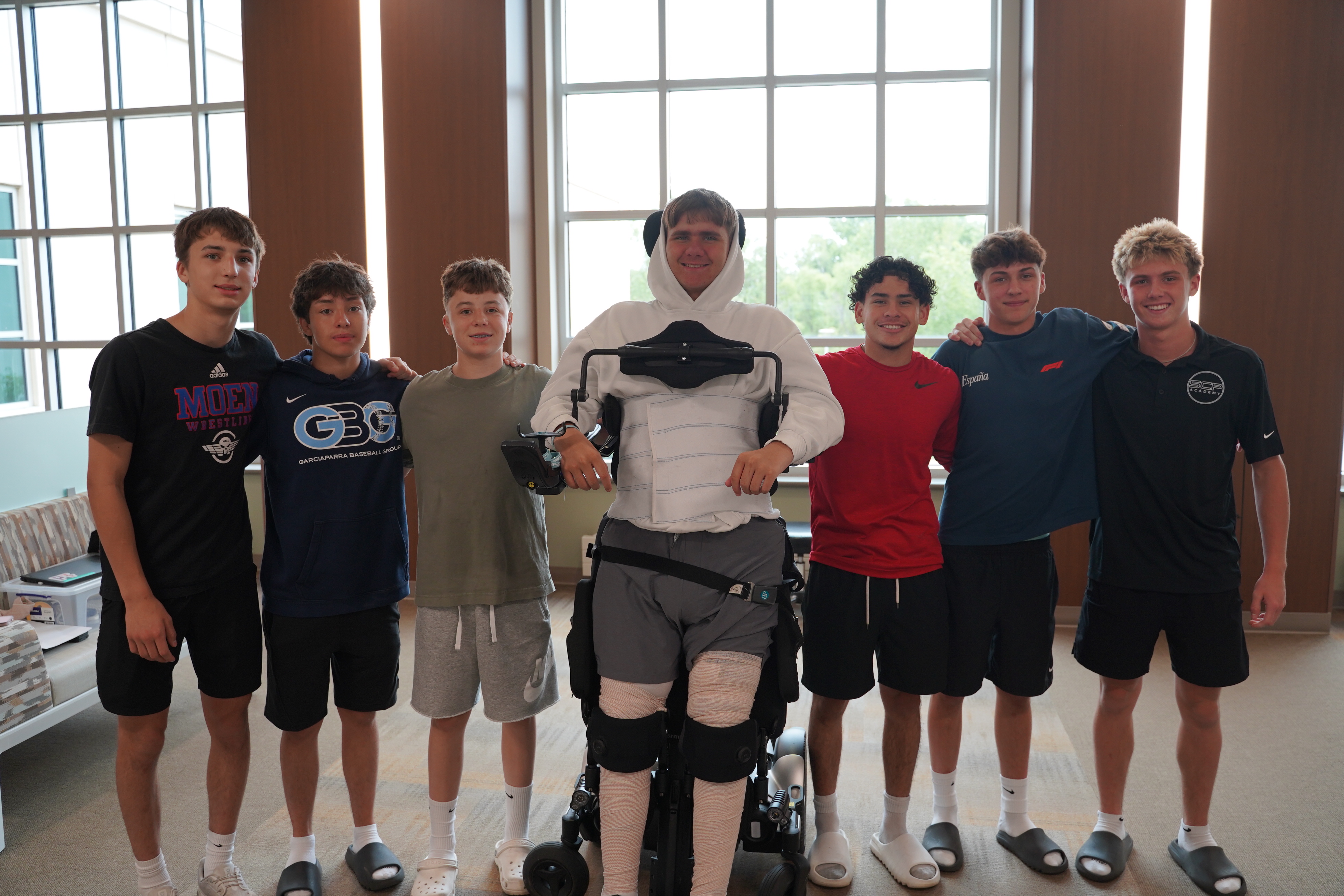
For most high school wrestlers, a Saturday match is just another day in the pursuit of a goal. For Iowa teenager Layne Hearne, one match changed everything.
“I was in a wrestling accident on May 3,” Layne said. “It was just a normal day and wrestled a normal match. It was good and I just landed wrong, just an unfortunate situation.”
After sustaining a spinal cord injury, Layne began a new journey at Madonna Rehabilitation Hospitals, where the skills that made him successful as an athlete would become just as important in recovery.
A Competitor’s Mentality
When Layne arrived at Madonna’s specialized pediatric spinal cord injury program, the challenges were significant.
“When I first met Layne, his biggest deficits were just overall the inability to move,” Bailey Leversee, PT, DPT, Layne’s physical therapist, said. “He could only partially move his upper extremities. He could not roll in bed. He could not move his trunk, legs, or move himself to reposition whatsoever.”
For Layne, rehabilitation wasn’t just about strength. It was about relearning the everyday tasks that support independence.
“We were working on relearning all of his self-care skills,” Lauren Cox, OTD, OTR/L, Layne’s occupational therapist, said. “That included being able to brush his teeth, bring a washcloth to his face and hold different items to help with personal hygiene.”
Despite the obstacles, Layne approached rehabilitation with the same mindset that had served him on the wrestling mat.
“Never giving up, grinding through it, being comfortable in the uncomfortable,” he said. “It’s kind of a quote we’ve always said in the wrestling room. It’s not where I want to be, but just grinding through it and getting through it. It’s no different than wrestling practice.”
That determination quickly became apparent to his care team.
“He had the mindset that he was going to be a competitor, and he was never going to give up,” Leversee said. “He worked really hard each and every day.”
Relearning Skills, Building Independence
Throughout his rehabilitation stay, the focus was on helping Layne regain as much independence as possible.
“For Layne, we had goals for self-care and we also had goals for overall use of his upper body and his arms,” Cox said. “Some of those goals included being able to grasp and release objects, manage containers, manage fasteners like zippers and buttons, and improve his overall strength.”
To help Layne reach his goals, his therapy team combined determination, innovation and specialized rehabilitation technology.
“With Layne, we used the FES bike and the standing frame because he was unable to move his legs by himself,” Leversee said. “We had to find a way to keep them moving for bone and muscle health.”
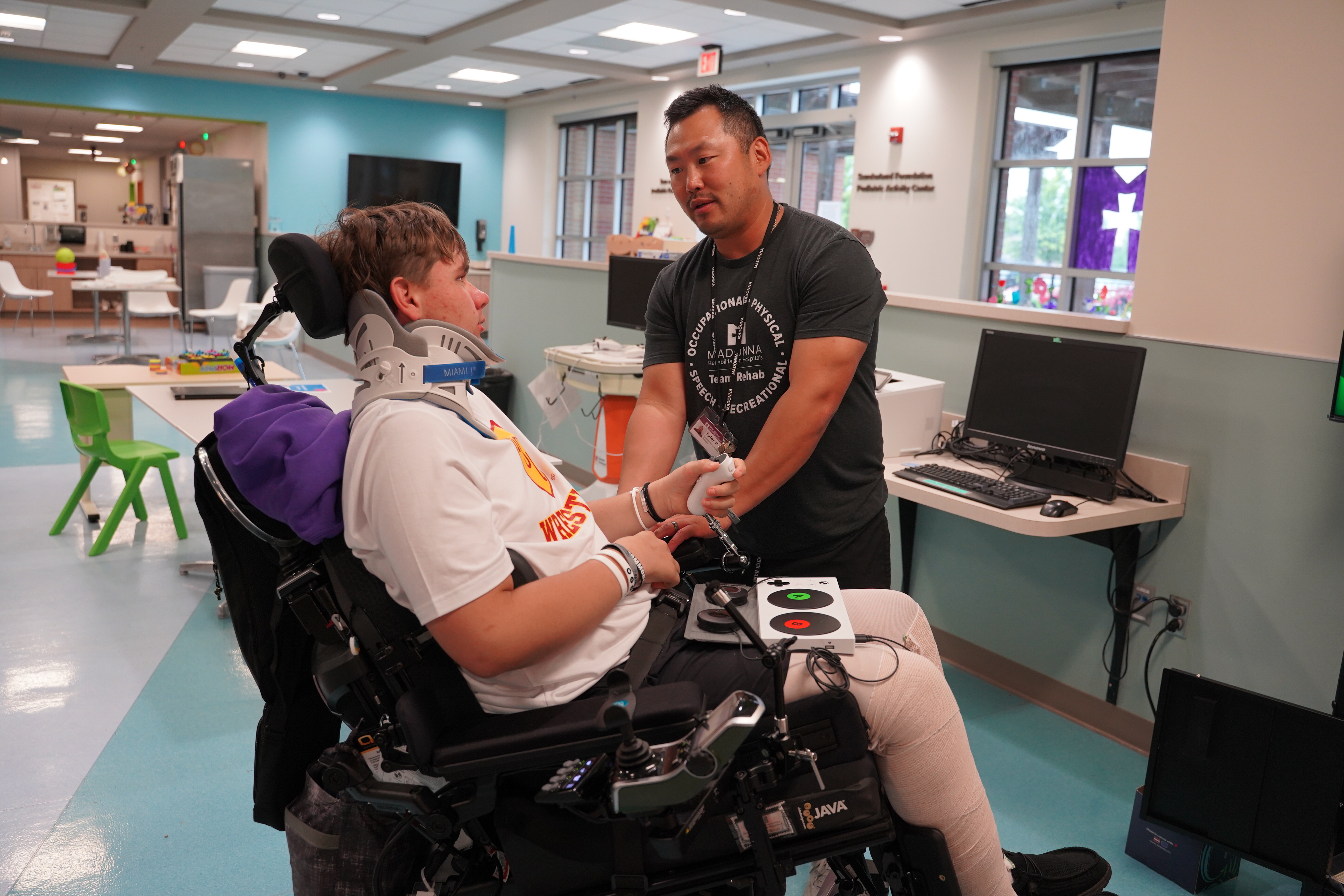
Occupational therapy also included adaptive technology and a driving simulator.
“We used the driving simulator to try out hand controls,” Cox said. “He also did a lot with adaptive technology to help him get back to video games, which was really important for him. We also used the FES bike just to increase the activation of his triceps and build his overall strength with mass repetition.”
Exceeding Expectations
As the weeks passed, Layne continued to achieve milestone after milestone.
“He surprised us each and every day,” Leversee said. “He showed us that he could do everything we wanted him to do and more.”
Layne’s care team also noticed daily improvements in his function and mobility.
“Layne was using a mechanical lift when he got here,” Cox said. “By the time he left, he was transferring with one helper. He did a really great job of adapting to his current function and what his body is able to demonstrate.”
Layne sees that progress too.
“Getting here, I couldn’t do much of anything,” he said. “I couldn’t even sit up without feeling nauseous and feeling like I’m going to pass out. But now, I’m standing with assistance and tolerating that well. I’ve made so many improvements with dexterity and strength that I didn’t have before.”
“Captain Layne”
While his physical progress impressed his therapists, his attitude left an equally lasting impact.
“Layne is such a leader,” Cox said. “From the time that he got to Madonna to the time that he left, we referred to him as ‘Captain Layne,’ captain of the unit, because he embodied so many leadership characteristics.”
According to Cox, even while facing his own recovery, Layne continued encouraging others.
“His ability to be a teammate and a leader and coach and encourage others continued,” she said.
Layne’s mom, Laine Weston, saw that same resilience every day.
“At first it’s heartbreaking, but then it’s inspiring,” she said. “He’s a very independent, get-after-it kid, and for that to be just halted is really a punch in the chest. But just seeing him have his spirits high every day has been inspiring.”
Choosing Positivity
One phrase became a defining theme throughout Layne’s stay.
“It was perfectly written on his bracelet, his mantra, ‘Win the Day,'” Cox said. “He took the positive out of every day and kept capitalizing on that.”
Layne credits that outlook with helping him navigate recovery.
“Everyone I talk to, they always say, ‘A positive attitude will get you a lot further than a negative one,’ so as long as I stay positive, I know I’ll continue to make improvements,” he said. Layne’s mom says she believes that ability to keep moving forward, even during difficult moments, is one of his greatest strengths.
“I see when he gets frustrated and I see when he pulls himself out of it,” Weston said. “This situation makes it a lot more tough, and he just does it with grace.”
Looking Ahead
As Layne transitions to the next phase of rehabilitation and eventually returns home, his goals remain focused on building independence and embracing what he calls his “new normal.”
“Here soon, it’s back to the normal routine, or the new normal anyway,” Layne said. “Back at home, football, school, all the things that kind of bring me back down to Earth a little bit.”
For families facing similar challenges, both Layne and his mom offer simple but powerful advice.
“Your attitude goes a long way,” Layne said. “Just keeping a positive attitude, it will get you a lot further than you think it will.”
Weston encourages families to accept support when it’s offered.
“I definitely learned to lean on that more in this situation,” she said. “The people that just want to bring a meal or help, just let them.”
Even the toughest competitors need a team to support them and cheer them on.
“We just appreciate the therapy team here that really has treated Layne like their own,” Weston added. “They praise his successes and push him in the hard moments and have been really real with him. The progress that he’s made in just a few weeks is just crazy to me, and it’s thanks to them.”
For a wrestler who has spent years learning how to push through adversity, recovery has become a different kind of competition, one that continues to be guided by determination, resilience and a commitment to win the day.