
When Omaha native Rachel Mathis arrived at Madonna Rehabilitation Hospitals after a ruptured brain aneurysm, she faced challenges that affected nearly every aspect of daily life. She struggled to communicate her needs. She couldn’t stand or walk independently. Even simple tasks required help.
For Rachel and her husband, Armando Hernandez, the road ahead felt uncertain.
“She passed out and started throwing up and then she went into sleepy mode,” Armando said. “For us, that was not normal, so we called 911 and that’s how her life was saved.”
As Rachel began inpatient rehabilitation at Madonna, her physician-led care team quickly recognized that recovery would require more than rebuilding physical strength. It would require trust.
“The first few weeks were actually really tough,” Hannah Lutz, PT, DPT, Rachel’s physical therapist, said. “It was hard for her to trust us, but after she trusted us, it really allowed me to see her full potential and how far she could come.”
At Madonna, clinicians work to understand where each patient is physically, cognitively and emotionally, and build a plan that helps them move forward with confidence. For Rachel, that meant meeting her where she was in those early days of recovery. Also important was clear and consistent messaging across all aspects of her recovery, from therapies to physicians and nursing.
“I made it very clear to her that I was not going to sugarcoat things,” Paige Schlachter, MS, CCC-SLP, Rachel’s speech-language pathologist, said. “I would never lie to her. If I’m telling her she’s doing well, she’s really doing well. If I tell her that she’s struggling, it’s because I’m really seeing her struggle.”
Helping Rachel understand the purpose behind difficult therapy sessions was essential.
“A lot of the time the looming question was, ‘Why?'” Faith Lambrecht, OTD, OTR/L, Rachel’s occupational therapist, said. “Why are we doing this? Why is this hard? What’s the point? Being able to provide that education and explain why we have to do these hard things was important.”
Early in her recovery, Rachel often participated in physical and occupational therapy co-treatments, allowing therapists to safely work together on complex mobility and daily living tasks.
“We started calling our co-treats ‘girl time,'” Lutz said. “Having two professionals asking you to do difficult things can be intimidating. Giving it a different name helped ease some of that fear and anxiety while we built trust.”
The co-treats were also important from an emotional standpoint.
“Knowing that she had consistent therapists she could rely on and start to trust, even though we pushed her hard, helped us build that camaraderie while she was doing all these hard things,” Lambrecht said.
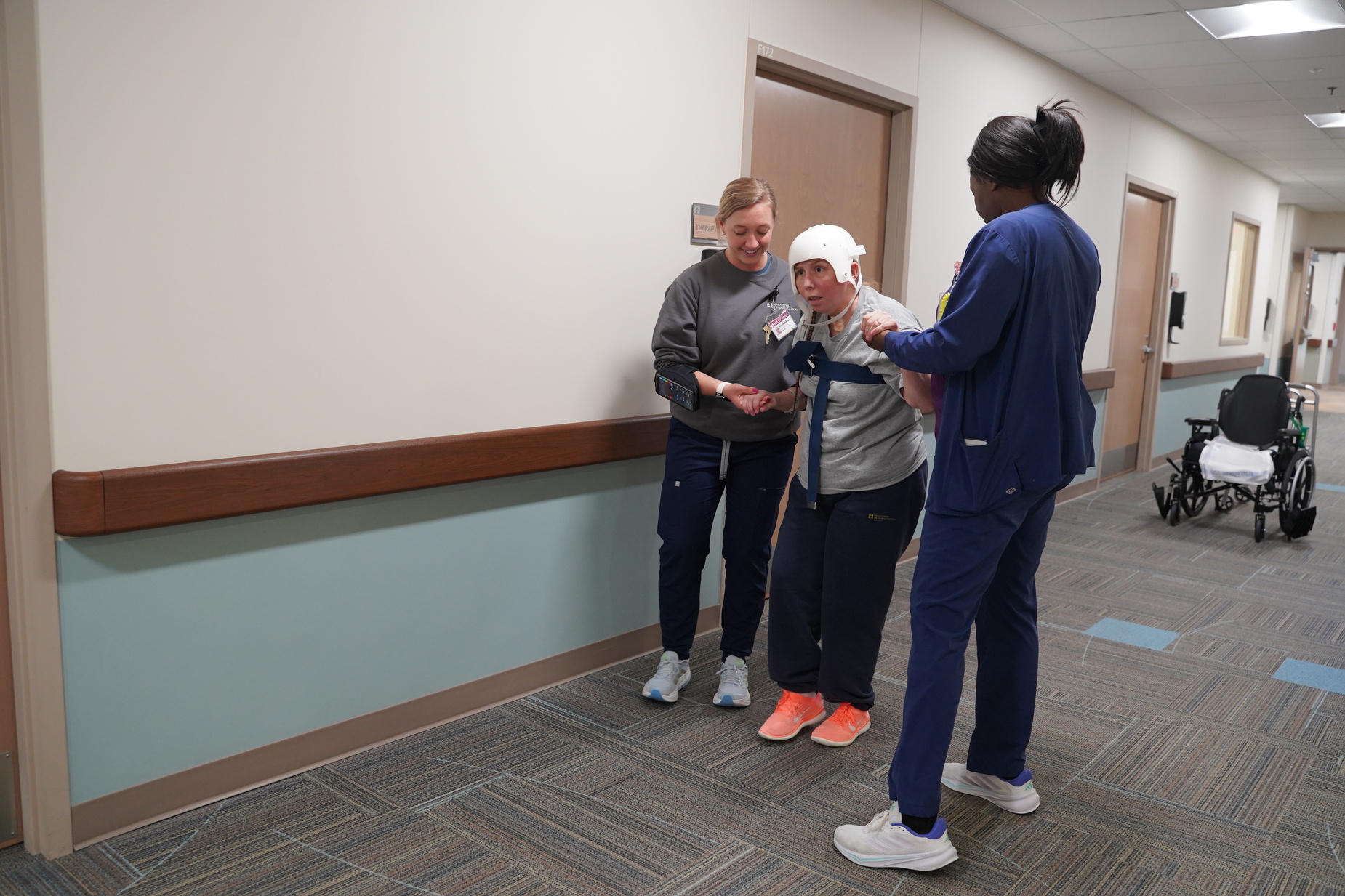
At the beginning of her stay, Rachel needed extensive assistance just to stand.
“Some of our goals were just to get her on her feet, to get her to tolerate standing and then start taking those first few steps,” Lambrecht said. “We wanted to create confidence in her and help her get more comfortable with being uncomfortable in therapy.”
The idea of being comfortable with the uncomfortable became central to Rachel’s recovery journey. Whenever she doubted herself, her therapy team responded with the same message.
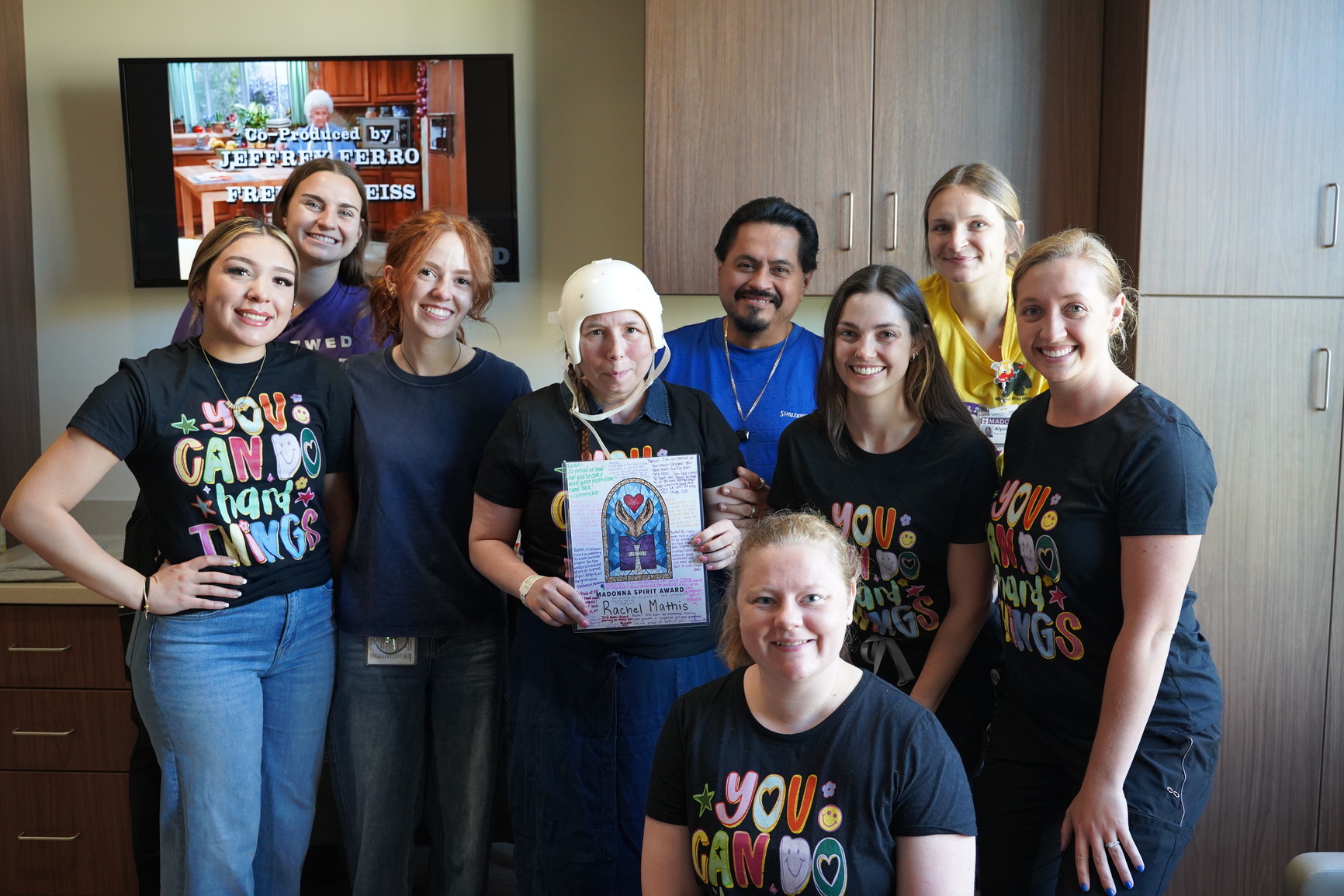
“When she was here, she would often say, ‘I can’t do that,'” Lutz said. “We’d say, ‘Well, let’s try.’ Then when she succeeded, we’d tell her, ‘See? You can do it. You can do hard things.'”
Those small victories began adding up. One of Rachel’s biggest milestones came when she started walking again. The moment represented more than a physical accomplishment. It was proof that Rachel was capable of more than she believed possible just weeks earlier.
Throughout her recovery, Armando remained a constant source of support.
“I seriously don’t think there was a day that he was not here,” Lambrecht said. “Armando was there every step of the way, always encouraging Rachel to keep pushing and try just a little bit more.”
Rachel described her husband of 19 years as her rock.
“He would work every night and then show up the next day at 7 a.m. ready to be in therapy, support her and encourage her,” Lutz said. “Not just physically, but emotionally.”
As Rachel’s progress accelerated, Armando says he gained a new appreciation for the therapists challenging her every day.
“At the beginning, she said she didn’t like Hannah because she pushed her hard,” Armando said with a laugh. “Now she says she likes her because she pushed her. They were hard, but then I understood that’s their job. That’s how patients get better.”
By the time Rachel was ready to return home, the progress was remarkable. She was regaining independence in daily activities.
“She went from not really being able to tell us what she wanted or needed to participating in medical decision-making with doctors,” Schlachter said. “Her cognition has grown so much.”
For Armando, the results spoke for themselves.
“I needed her to walk, she’s walking,” he said. “They taught her how to eat. She’s eating now. They taught her a lot of things that I need her to know before we go home.”
By trusting the process and taking on one challenge at a time, Rachel discovered what her care team had been telling her all along: She could do hard things.