
According to the American Heart Association, someone in the United States has a stroke every 40 seconds. While stroke remains a leading cause of disability across all age groups, Madonna Rehabilitation Hospitals has seen an increase in young stroke survivors needing intensive medical rehabilitation.
At 26, Tatum Zornes was a healthy, active and independent young adult — until a hemorrhagic stroke in March left her unable to move the left side of her body.
She had laid down for a nap when she suddenly felt numbness throughout her body and called for her mother, who immediately recognized the symptoms.
Doctors believe Tatum’s stroke was caused by high blood pressure.
“I truly haven’t even processed it,” Tatum said of her stroke. “It just happened and now I’m going through the motions of healing.”
Driven to Regain Independence
When she arrived at Madonna Rehabilitation Hospitals’ specialized stroke rehabilitation program, Tatum lacked the strength and coordination needed for activities of daily living such as dressing, cooking and cleaning. That sudden loss of independence was especially difficult for someone used to caring for others.
“I have back problems and she’s just been my angel,” Lisa Zornes, Tatum’s mother, said. “She’s my angel, and it’s just been hard to see her go through all of this.”
Even when her body would not cooperate, Tatum’s determination stood out to her care team.
“Tatum’s prior level of function was very active, so she loves to hang out with her friends and work and do lots of things out in the community,” Aubrey Janousek, MOT, OTR/L, CBIS, Tatum’s occupational therapist, said. “Because of that, that looks a little bit different in terms of motivation.”
That motivation helped fuel her recovery.
“For people who are younger who have had a stroke, it’s scary to think about what life is going to look like, and they’re very driven to get back to doing the things they want to do,” Ryan Knight, PT, DPT, Tatum’s physical therapist, said. “It opens up some different possibilities of interventions and different therapeutic activities we’re going to try.”
Early Mobility Jumpstarts Recovery
Research shows early mobilization can improve stroke recovery outcomes.
Even though she could not stand on her own, Knight got Tatum up and walking using the LiteGait body-weight support system, allowing for mass repetition early in her recovery.
“Without a significant amount of support, it was really hard for Tatum to safely take steps,” Knight said. “That body-weight support gave Tatum a sense of safety and security that allowed her to start exploring some movement possibilities with that left leg that were hard to do outside of that piece of equipment.”
Each day, Tatum’s leg strength improved. She progressed from requiring maximum support in the LiteGait to walking with a cane and climbing stairs.
“She just continues to push herself and push me to challenge her in new ways,” Knight said. “She’s always got a great sense of grace for herself and others as we’re being challenged together, and even if we aren’t successful the first time, we’re going to try it and see how it goes.”
Relearning Daily Life After Stroke
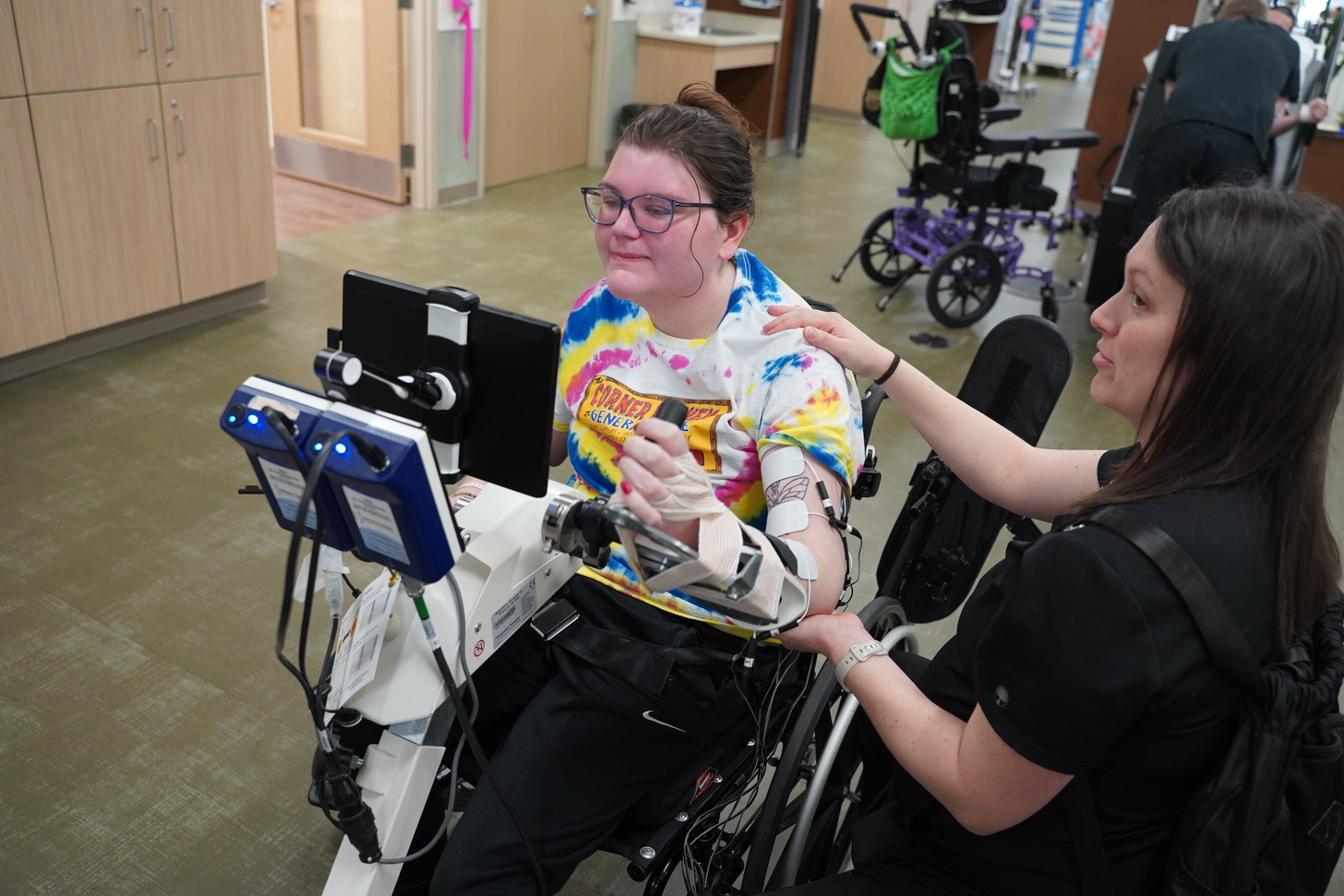
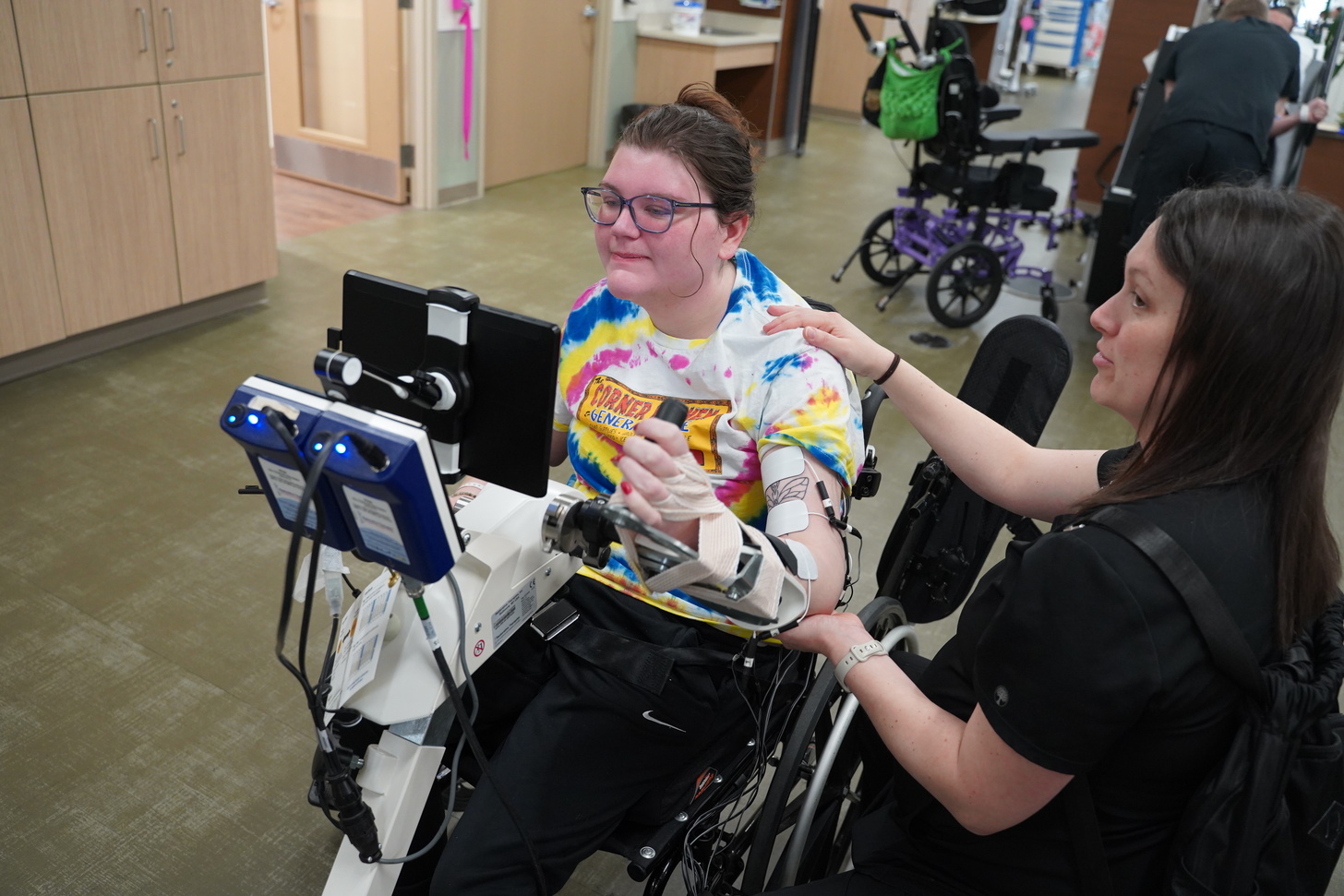
As her lower-body strength improved, occupational therapy focused on Tatum’s upper body, using specialized technology such as the functional electrical stimulation (FES) bike to activate weakened arm muscles.
Lisa also completed caregiver training to learn how to help Tatum navigate daily tasks in new ways.
“This has been such a life-changing event for her, and she does tell me a lot, ‘I’m new to having a disability, so I don’t know how to do this,’” Janousek said. “But she’s willing to work through it and problem-solve it.”
Lisa and Tatum practiced new techniques during evenings and weekends, reinforcing therapy strategies outside scheduled sessions. That extra work helped accelerate Tatum’s progress.
“Every day, she’s recalling what we taught her and implementing it so that she can be more and more independent,” Janousek said. “Going through your twenties is hard enough, and then having a serious stroke like this really impacts your future. She’s just taken it in stride and continues to set new and bigger goals for herself that I know she’ll achieve.”
Relearning How to Swallow Safely
Rehabilitation did not stop with Tatum’s arms and legs. She also worked with speech therapy to strengthen the muscles in her neck and throat so she could swallow safely.
“She was on moderately thick liquids when I evaluated her, and that’s pretty thick compared to water,” Mary McCallum, MS, CCC-SLP, Tatum’s speech-language pathologist, said. “That impacts quality of life, so she was really motivated to work on her dysphagia.”
After undergoing a fiberoptic endoscopic evaluation of swallowing, or FEES, Tatum’s team better understood what she needed to safely return to her favorite foods and drinks.
McCallum used VitalStim electrodes on Tatum’s throat to activate swallowing muscles and the Iowa Oral Performance Instrument to strengthen her tongue.
“I like to say it’s like doing a bicep curl, but more for your swallowing muscles,” McCallum said.
With daily intensive speech therapy, Tatum resumed an unrestricted diet and took her first sip of regular water in six weeks.
“It was absolute heaven,” Tatum said. “You don’t think about that until you can’t have it, and then it’s all you can think about.”
Recovery Rooted in Resilience
Through it all, Tatum and Lisa say humor has been essential to recovery. The pair even earned a Madonna Spirit Award for their hard work and positive attitude.
“Just take it as it comes, really,” Tatum said. “Try to make a happy situation out of a bad situation.”
Lisa agrees that recovery can be a roller coaster, but says the progress is steady.
“Every day is better,” she said. “Every single day gets better.”
Looking back on the past two months, Tatum said she is nearly unrecognizable from the patient who first arrived in the intensive care unit at CHI Health Bergan Mercy. Now, she says, her future is full of possibility.
“I’ve made so much progress here at Madonna,” she said. “I would like to see how much more I can continue to make and I’m just excited for the adventure that comes with it.”