
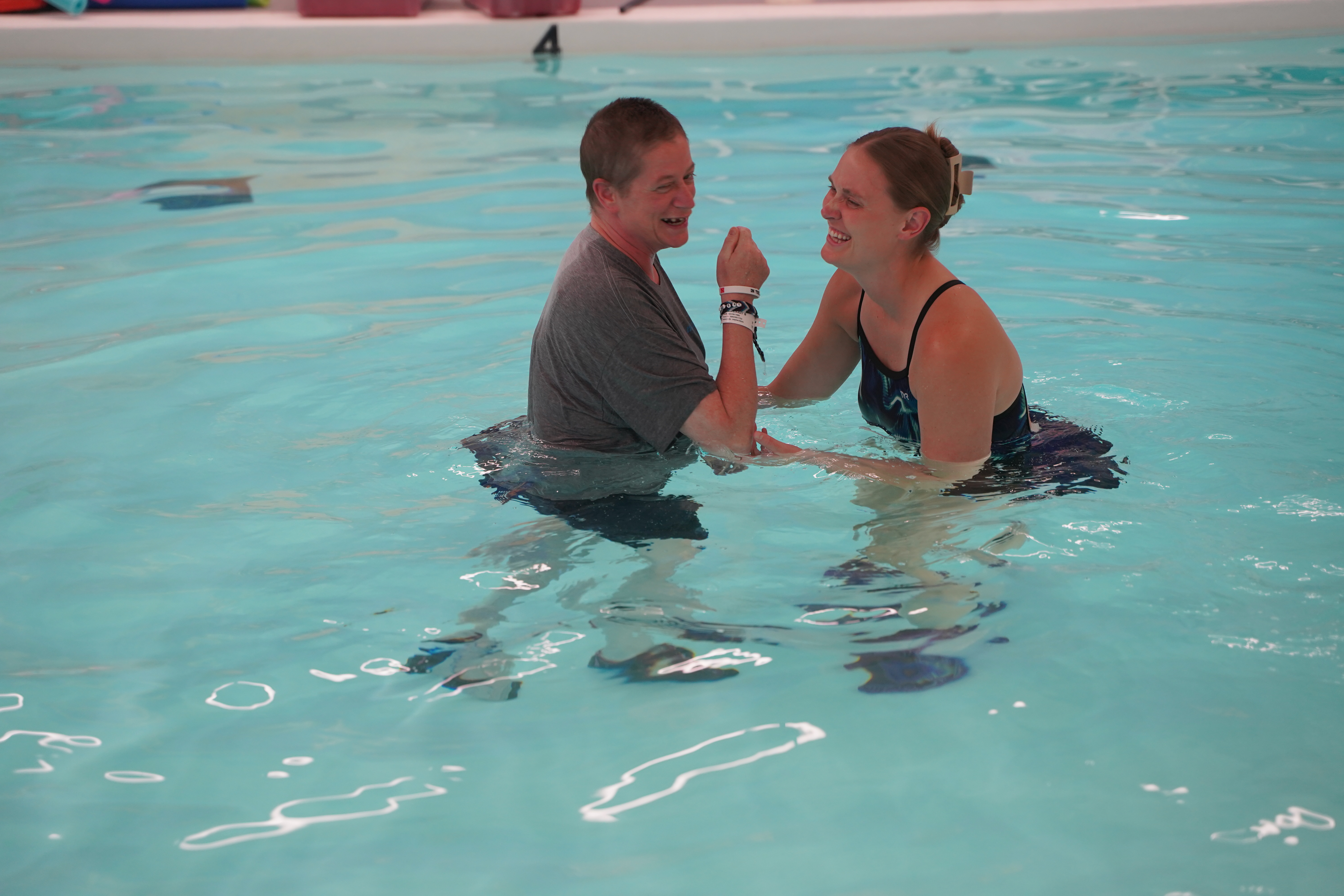
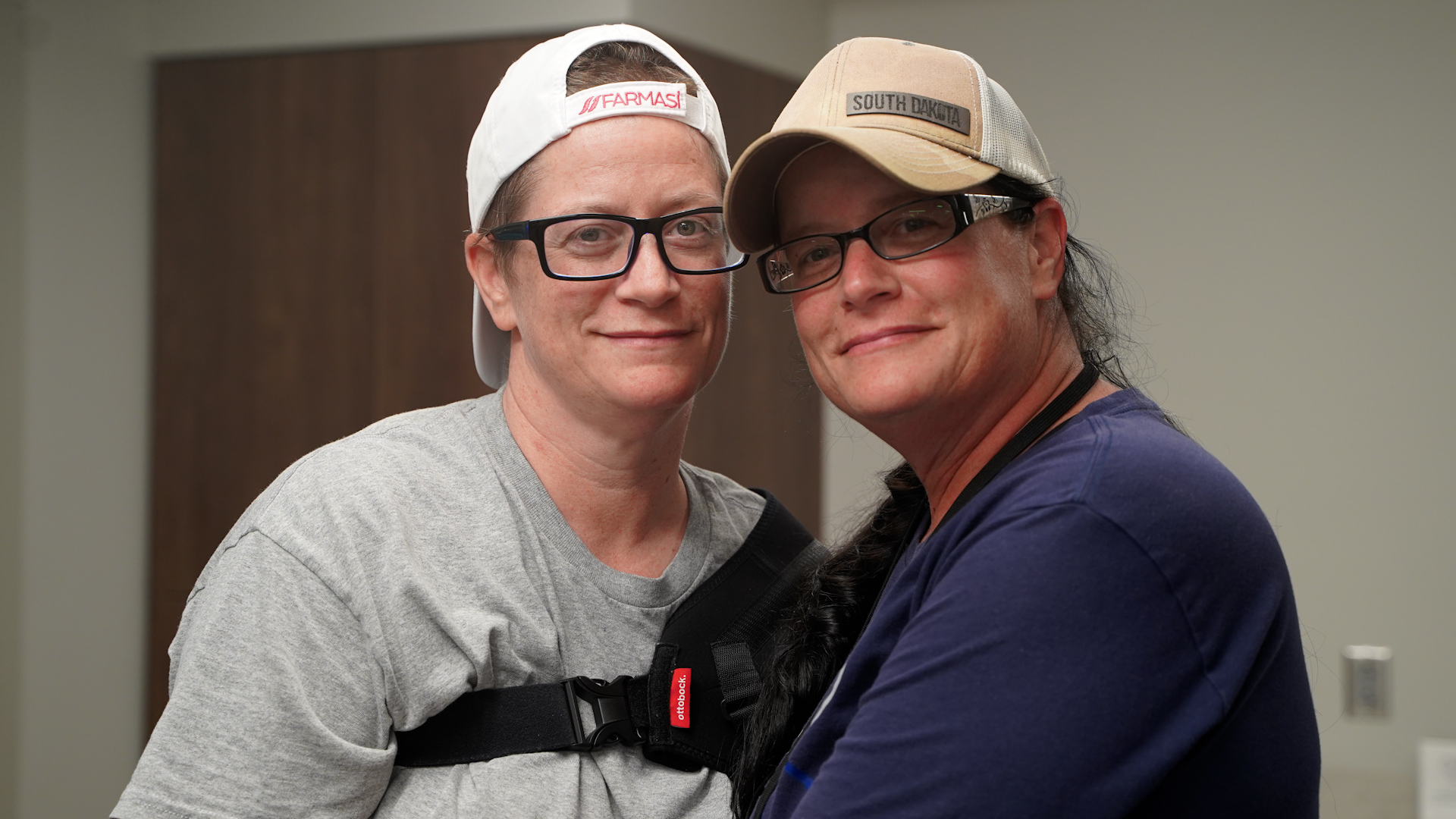
“It’s going to take a long road ahead of me and a big team,” Kasey Lysenko said. “I’m lucky to be alive.”
Before Kasey ever arrived at Madonna Rehabilitation Hospitals, her recovery had already become a team effort.
The 44-year-old Scottsbluff preschool teacher remembers little about the day she experienced her stroke.
“I was on my back porch and I just collapsed,” she said.
After being taken to Scottsbluff’s Regional West Medical Center, she was transferred to HCA HealthONE Swedish in Englewood, Colorado. As Kasey recovered, Kendra began researching rehabilitation hospitals that would help her sister move forward.
“My sister took the lead in the whole situation,” Kasey said. “She googled a whole bunch of places, and then she chose this one. She made all the phone calls. When I woke up, she was like, ‘You’re going to Madonna.’”
Choosing Madonna’s specialized stroke program was only the beginning. Kendra temporarily relocated to Lincoln, attended therapy sessions and learned how to safely assist her sister.
“Her sister Kendra was awesome,” Sara Hohensee, PT, DPT, CBIS, a Madonna physical therapist, said. “She was her biggest advocate. She was always willing to get hands on, to train and to assist Kasey. She was there for her physically, emotionally and mentally.”
Kendra became an important part of Kasey’s recovery, but she wasn’t alone. At Madonna, that support expanded to include an interdisciplinary team of physiatrists, therapists, nurses and rehabilitation specialists, all working toward one shared goal: helping Kasey return home to her three children.
Rebuilding After Stroke
When Kasey arrived at Madonna, the effects of her stroke were significant.
“When she got here, she was not moving her left side at all,” Hohensee said. “Her left arm and her left leg were pretty much completely lifeless. She required two people for all movement.”
“I couldn’t even sit up straight,” Kasey said. “I couldn’t dress myself. My left side is just gone.”
Madonna’s interdisciplinary team developed a rehabilitation plan centered on high-intensity gait training and high-volume, task-specific practice to help retrain the connection between Kasey’s brain and body.
“We used body weight supported treadmill training to really get that repetition and intensity of that walking,” Hohensee said. “We were able to really increase her speed and make it a much more intense, higher-demand task, which carried over really nicely into her overground walking.”
The progress was remarkable.
“When she first came to Madonna, I had to physically lift and advance her entire left leg to walk with her,” Hohensee said. “By the time she discharged, she was walking about 1,000 feet with one person. She was doing stairs. She gained control of her left leg and didn’t require any assistance at all to advance her left leg.”
For Hohensee, Kasey’s progress reinforced the importance of beginning specialized stroke rehabilitation as early as possible.
“Coming here right after her stroke made a huge difference because the amount of therapy, the intensity of the therapy and the duration of therapy she was able to get here at Madonna is such a game changer when it comes to stroke rehab,” Hohensee said. “The more you can get, the higher intensity, the more frequent you can get is what is going to give you the best possible outcome with stroke recovery.”
Never Losing Sight of Home
For Kasey, every therapy session had a greater purpose.
“I wanted to go home to take care of my children,” she said.
Throughout her stay, Kendra remained by her side while family members made the eight-hour trips from western Nebraska so Kasey could spend time with her children. Those visits reminded her why every therapy session mattered.
“Kasey talked a lot about her kids and used them as her biggest motivation for therapy,” Hohensee said. “She kept showing up, kept working really hard, knowing that returning home to them was her end goal and her biggest motivator.”
The Power of a Team
Recovery wasn’t something Kasey faced alone.
Her family kept her focused on the future. Her care team challenged her, encouraged her and celebrated every milestone along the way.
“My team has been really great,” she said. “When you think you just look ridiculous or think you can’t do it, they’ll just motivate you into thinking all that’s just not true.”
Hohensee remembers that attitude just as much as Kasey’s physical progress.
“Kasey was so fun to work with,” she said. “Every session she found a way to make me laugh. She always took her rehab very seriously but had the perfect balance of bringing in humor and laughter and really hard work.”
Today, Kasey continues her recovery with her family back in Scottsbluff, carrying with her the support of the team that helped her get there.
For others beginning their own recovery journey, she offers simple advice:
“You’re going to get there,” she said. “You gotta take deep breaths and see it to believe it. At first you’re just like, ‘Get real.’ But then when you start seeing other people doing it and then you do it yourself, you’re like, ‘Yep, I’m going to do it.'”