
Finding Hope and Independence Through a Specialized Stroke Rehabilitation Program
Stroke recovery can be isolating and overwhelming. In a moment when it feels like your whole world has changed, the people around you can make all the difference.
After a stroke in January left him unable to move the right side of his body, Keith Siebels found himself facing a future he hadn’t imagined.
“When I was in ICU at Methodist, a lot of bad things went through my head,” Keith said. “I didn’t want to be a hinderance to anyone. I didn’t want to live like that.”
Before his stroke, Keith was active, independent and always on the move. Suddenly, even the most basic tasks, like getting out of bed, getting dressed or using his dominant hand, required assistance. But when he arrived at Madonna’s specialized stroke rehabilitation program, his outlook began to change.
From the start, Keith had a clear goal: to walk out of Madonna and return to living on his own.
“He hasn’t relied on anybody for his entire life,” said Kassi Pichler, PT, DPT, Keith’s physical therapist. “He was ready to be back on his own.”
Early on, even standing safely was a challenge due to weakness on his right side. But with the help of advanced rehabilitation technology, evidence-based approaches to movement and a highly specialized care team, Keith began rebuilding both strength and confidence.
Using tools like the Andago overground gait training system, therapists were able to safely challenge Keith as he relearned how to walk, allowing him to recognize and change his own movements in real time.
“When I first started working with Keith, he didn’t care that his right side didn’t work,” Pichler said. “He just kept walking and leaving the right side behind, but the Andago will allow him to fall and by showing him when he was making mistakes, he was able to slow down and correct himself.
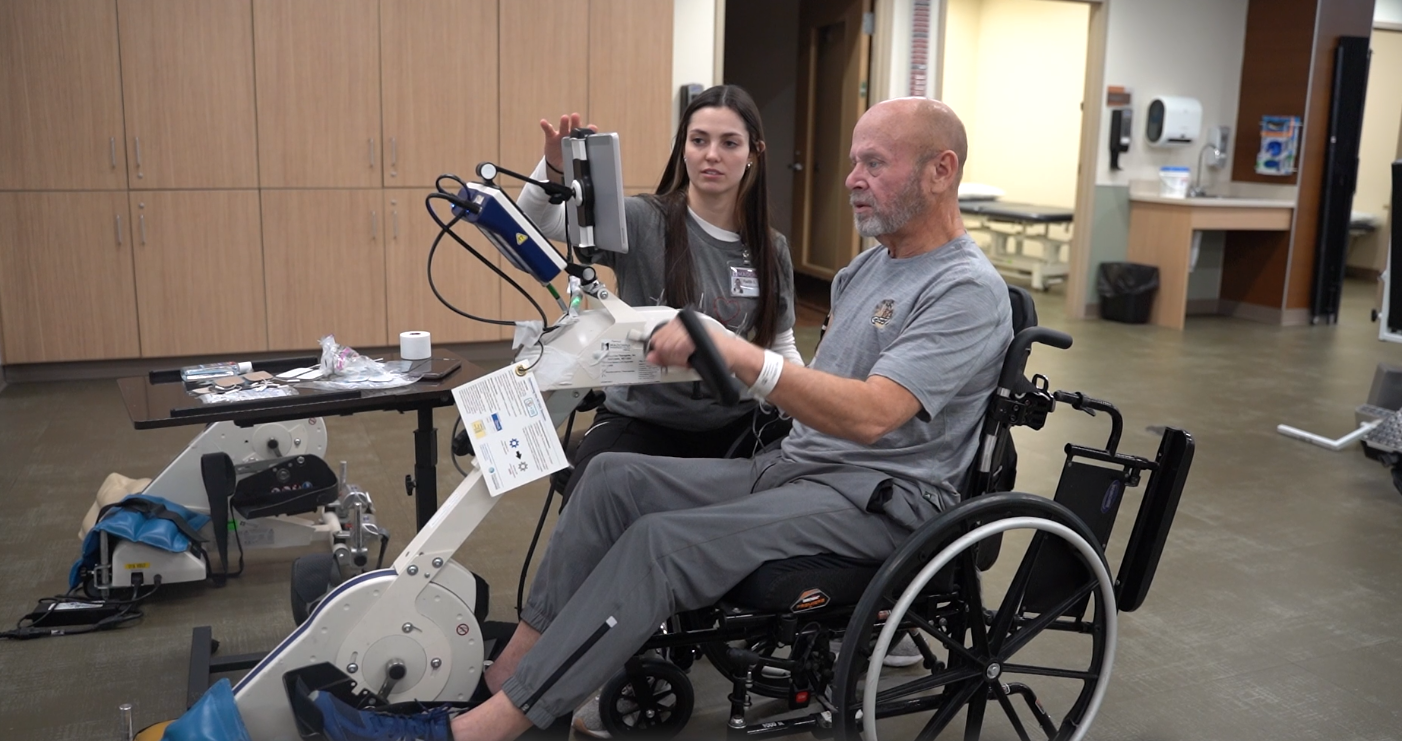
Occupational therapy also played a key role. Through technologies like functional electrical stimulation and robotic-assisted devices like the ArmeoSpring, Keith worked to regain movement and coordination in his arm while relearning everyday tasks.
“We kind of had to learn how to do everything initially from a wheelchair level,” Faith Lambrecht, MOT, OTR/L, Keith’s occupational therapist. “But he took it in stride.”
While the physical challenges were significant, Keith’s mindset became one of his greatest strengths. Utilizing Madonna’s neuropsychology services, he began to find humor in small things and learned strategies to cope with the difficult parts of recovery.
“Keith was very, very frustrated, to be honest, with the situation he was placed in, but every time I walked in the room, he was able to say, ‘I’m going to focus on what I can do,’” Pichler said.
That determination showed up consistently.
“My favorite part about working with Keith was that he showed up as his best version every day,” Lambrecht said. “Even if it was a good day or a bad day, he always put his best self forward.”
Outside of therapy sessions, Keith was just as committed, asking what more he could do to continue improving and working toward independence. In March, he achieved his goal of walking out of Madonna, but his journey wasn’t over. He moved through Madonna’s continuum of care to the Rehabilitation Day program on an outpatient basis.
As Keith worked toward recovery, he also became a source of encouragement for others.
“He just wants to be friends with anybody around him,” said Becca Saef, OTR/L, Keith’s outpatient occupational therapist. “Therapy is really hard and he wants to make the best of it all the time.”
His sense of humor and friendly nature earned Keith the nickname, ‘Mayor of Madonna.’
“Whenever we did our 1,000 laps up and down the hallway, we’d have to stop a couple times because everybody would want to say, ‘Hi, you’re doing great,’ and all of these things because he really found support and encouragement in others and became an encouragement for others,” Pichler said.
Whether he was stopping to talk with other patients in the hallway or offering encouragement during support groups, Keith built connections that helped create a sense of community, not just for himself, but for those around him.
“In a population where you can kind of feel very alone, having someone who wants to connect with people at Madonna and help them through it, is really exciting,” Saef said. “As far as the community here, I think he is going to be an ongoing positive influence.”
For Keith, that connection went both ways. On nights and weekends when there wasn’t therapy, he would wander the halls or stop by other patients’ rooms just to chat.
“I was just around if somebody wanted to talk and that also helped me,” Keith said.
Keith’s progress wasn’t his alone. His family played a critical role throughout his recovery, undergoing extensive caregiver training.
“His sister and his son were here almost every day,” Lambrecht said. “They were very brave. I threw a lot at all of them, and they said, ‘Ok, let’s just try.’ They learned how to provide that therapy outside of therapy and really worked hard.”
His son, Kyle, saw that effort pay off in meaningful ways.
“The one thing that really stood out is when he could shake my hand again,” Kyle said. “That was a testament that he’s put in the work.”
In just a short time, Keith made remarkable gains. From needing help with nearly every daily task, he progressed to living independently again—cooking, cleaning and managing his day-to-day routine. He’s returned to work and his beloved hobbies, including working on cars and guns, and he plans to return to Madonna as a peer volunteer.
Through hard work, humor and the support of a dedicated care team and family, Keith’s journey reflects what’s possible in stroke recovery. But for his son, the impact is even more personal.
“I just want to thank the care team for getting my dad back,” Kyle said. “There were some days we couldn’t see the light at the end of the tunnel. We’re starting to see it, and I have my dad back.”