
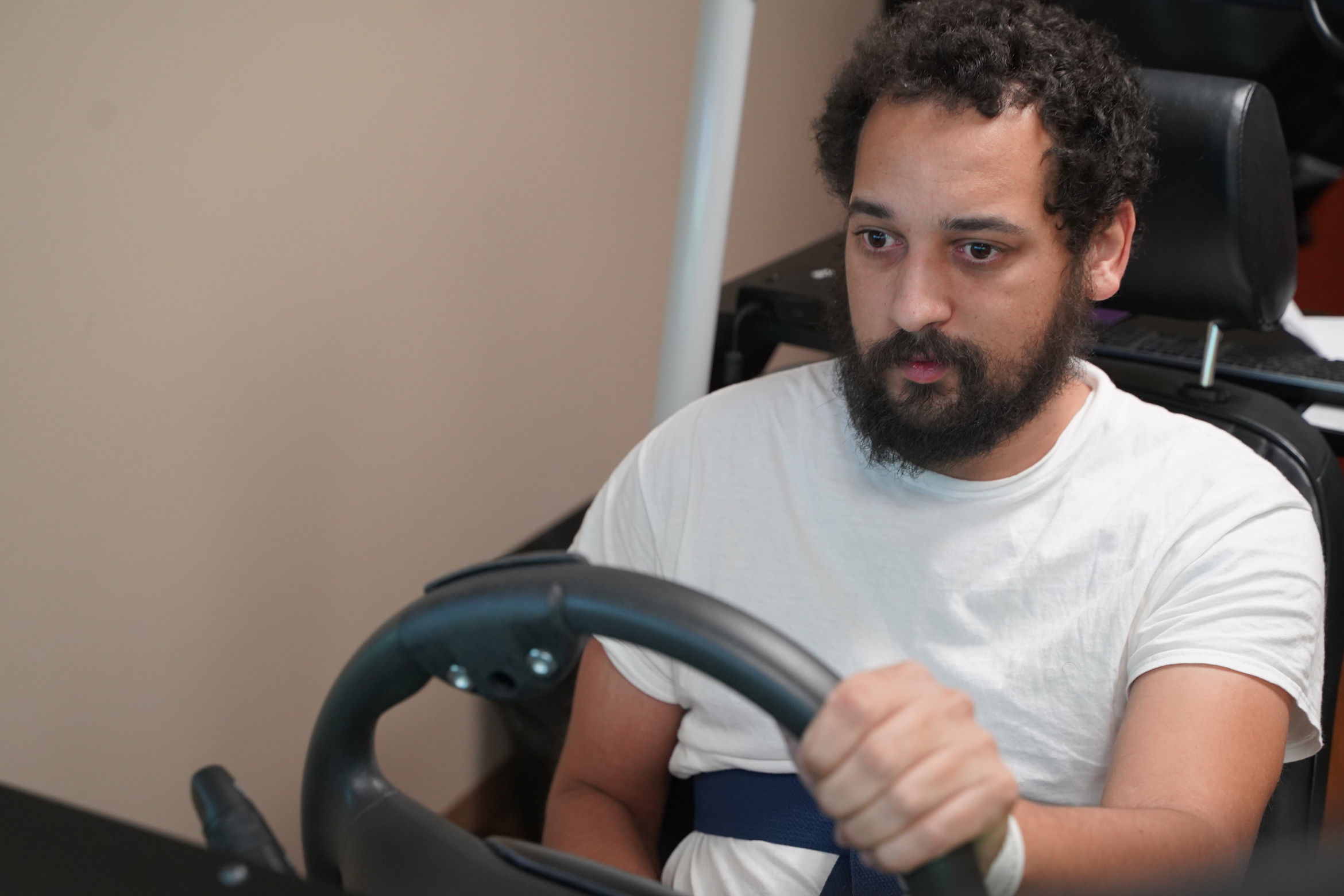
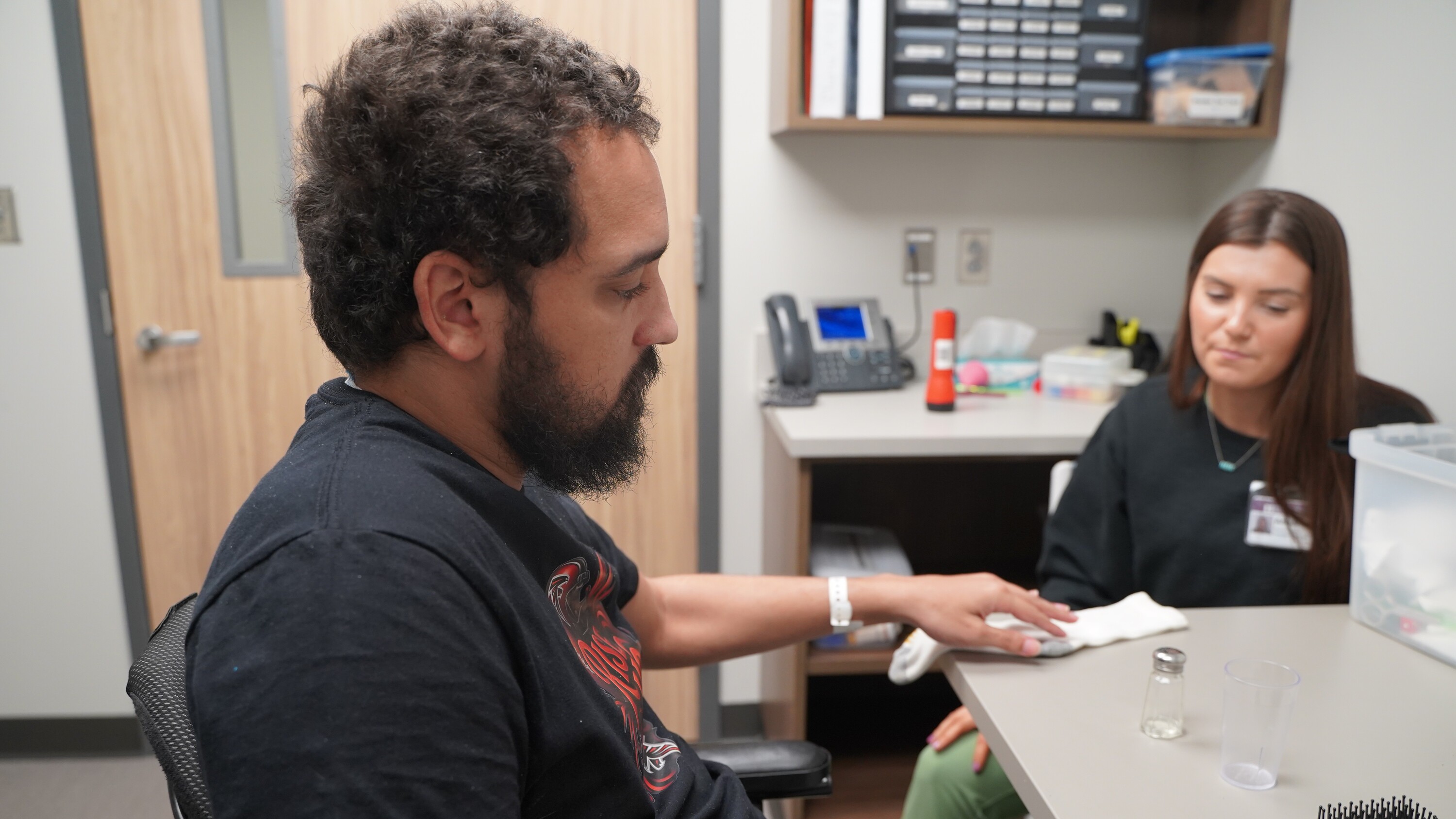
For Aaron McFarlin, stroke recovery became a process of relearning nearly every form of communication and movement.
After sustaining a stroke during a truck driving run in Missouri, the 34-year-old from Georgia spent several weeks in the intensive care unit at Mosaic Life Care in St. Joseph, Missouri, before arriving at Madonna Rehabilitation Hospitals’ specialized stroke program facing significant physical and communication challenges.
“He couldn’t walk at all. He didn’t have any balance at all,” Susan Highsmith, Aaron’s mother, said. “He wasn’t even really trying to talk much at all.”
Susan quickly realized the difference Madonna’s intense medical rehabilitation could make in her son’s recovery.
“I don’t know where he would be if he had not come here,” she said.
“Early rehabilitation for young stroke patients is essential to maximize recovery,” Dr. Adam Kafka, Medical Director of Madonna Rehabilitation Hospitals, said. “Due to their greater baseline neuroplasticity capacity and typically higher premorbid functioning, the first few months after a stroke are a critical window for neural reorganization and functional recovery.”
Communication Beyond Words
As Aaron began rebuilding movement and mobility, communicating his thoughts became one of the biggest challenges he faced.
“Having that pretty severe apraxia of speech, not being able to formulate that motor planning to get out what he wanted to say,” Annalise Connolly, MS, CCC-SLP, a speech-language pathologist, said. “Then having some of that word finding and that showing up in both the verbal expression and the written expression.”
But Aaron consistently found ways to connect.
“He had great facial expressions and great use of his gestures, and you could have a full conversation with him, even though he wasn’t able to verbally express his needs and what he wanted,” Connolly said. “Really just having him try and re-explain himself or using the whiteboard, see if he can write it too.”
Sometimes that meant drawing pictures instead of speaking.
“There was one day when I asked him what he had for breakfast, and he could not write it, and he could not tell me,” she said. “So, he drew me what he had for breakfast.”
Aaron used similar strategies in other conversations, including drawing a baseball when he wanted to talk about his favorite Georgia sports teams.
“Then being able to pull up a list of sports teams on the computer and then he was able to point and tell you his favorites,” Connolly said. “Using those different forms of communication and different access to technology that we have, was super helpful when he couldn’t express what he wanted to say.”
Despite the communication barriers, many of Aaron’s cognitive abilities remained intact.
“That problem solving and awareness and even pathfinding… he still was super successful with and had that just really ingrained in him,” she said.
Therapy Strategies Extended Across Every Discipline
At Madonna, Aaron’s communication strategies became part of every therapy session.
“I had asked (his occupational therapist) Sarah (Synek) and (his physical therapist) Sara (Hohensee), hey, what tools are you using in therapy?” Connolly said. “What would be helpful information for you to have in that communication book?”
Communication boards, written cues and therapy-specific vocabulary helped bridge gaps between disciplines.
“We were able to work really closely with his speech therapist and communicate what strategies we can use,” Sara Hohensee, PT, DPT, CBIS, a Madonna physical therapist, said. “Ultimately, we were able to communicate with Aaron in a way that may not be verbalizing, but in a way that was really helpful.”
That collaboration became especially important because Aaron’s rehabilitation demanded high-intensity care.
High-Intensity Rehabilitation Helped Restore Mobility
Aaron’s physical rehabilitation centered around repetition, cardiovascular intensity and progressively more difficult movement challenges.
“We were putting ankle weights on him. We were having him do stairs and agility ladders,” Hohensee said. “We had him on our bodyweight support treadmill, just doing tons and tons of walking.”
When Aaron first arrived, even walking required significant assistance.
“The first time we walked with him, we used a really big rolling platform walker and I had to help Aaron’s right leg every step that he took,” Hohensee said.
Sara said repetition and intensity were critical components of Aaron’s recovery.
“The more repetition at the higher intensity is going to give us our best results when it comes to someone like Aaron, who is so young and has had a stroke,” she said.
But the progress was dramatic.
“By the time he left us, he was walking really with someone just providing supervision,” she said. “When he left us, he wasn’t using any type of assistive device.”
Occupational therapy helped translate those physical gains into everyday independence.
“When I first met Aaron, he had almost no movement of his upper arm,” Sarah Synek, OTD, OTR/L, a Madonna occupational therapist, said.
Therapy began with rebuilding larger, foundational movements before progressing into more detailed coordination and functional tasks.
“With Aaron, we started with more a gross motor focus,” Synek said. “Trying to get those big movements back before we started those smaller movements.”
As larger movements returned, therapy progressed into more detailed coordination and fine motor retraining.
“We used a lot of electrical stimulation to try to increase that movement that we saw and send signals back through the nerves up to the brain to activate that neuromuscular reeducation,” Synek said. “As we increased the electrical stimulation and stimmed not only the shoulder but the elbow and the hand, we were able to see a lot more increase in that fine motor coordination. And once we were able to do that, the sky was the limit.”
As Aaron progressed, therapy evolved into practical daily tasks.
“We could work on tying shoes,” Synek said. “We could work on handwriting, medication management, making meals, folding laundry and even returning to driving as well.”
Determination Drove the Recovery Process
Aaron’s therapy team said his attitude never wavered.
“Aaron was just always down for whatever I had in mind,” Hohensee said. “He would always be willing to work hard, to try new things.”
Therapists across every discipline saw the same determination.
“For how severe his communication deficits were, he never gave up,” Annalise said. “He never had a day that he didn’t want to work and didn’t want to work hard.”
When Aaron left Madonna, therapy had become part of his daily routine.
“We don’t have therapy on the day of discharge, and he was looking for his therapy sheet,” Connolly said. “He wrote down his therapists names and was wondering where his daily schedule was at.”
Synek said Aaron never lost sight of what he was working toward.
“I think Aaron understood why he was here, and he knew what inpatient rehab was and what the goal was for his treatment here,” Synek said. “I think he’d set a lot aside and really honed in and focused on what he was doing.”
That motivation never drifted far from the life he wanted to return to.
“He worked so, so, so hard every day,” Synek said. “I think he had that goal to go home, be with his son and go back to his life.”